
What to Expect in Your First Year with a Managed IT Service Provider
Partnering with a managed IT service provider is a big step for any business. Whether you’re a growing startup or an established enterprise, outsourcing IT management reshapes how you operate, scale, and secure your digital infrastructure. But what really happens during that first year?
Many businesses enter the partnership expecting instant transformation. In reality, the first 12 months follow a strategic progression – starting with stabilization, moving into optimization, and eventually driving measurable business growth.
In this guide, we walk through exactly what to expect in your first year with a managed IT service provider, broken down month by month to help you plan with clarity and confidence.
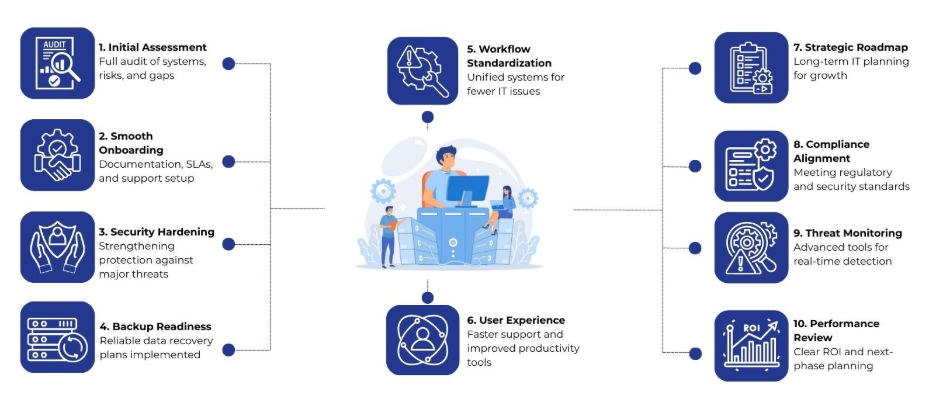
Month 1–2: Assessment, Onboarding, and IT Discovery
The early phase focuses on gaining full visibility into your existing IT environment.
Comprehensive IT Audit
Your managed IT service provider starts with a detailed assessment covering:
- Network infrastructure
- Servers and cloud systems
- Software applications
- Data storage practices
- Cybersecurity controls
- Hardware inventory
This stage uncovers vulnerabilities, inefficiencies, outdated tools, and performance gaps. The goal is to understand your current state before making recommendations.
Documentation and Knowledge Transfer
Existing IT documentation, if available, is reviewed. This includes:
- Administrative credentials
- Network diagrams
- Licensing details
- Backup configurations
- Vendor contracts
Where documentation is missing, the provider builds it from scratch. This process creates a centralized knowledge base that supports long-term stability.
SLA Finalization and Support Channels
You’ll receive defined service-level agreements (SLAs), outlining:
- Response times
- Resolution targets
- Support hours
- Escalation paths
Helpdesk access is activated through ticketing systems, phone, chat, or email.
Month 3–4: Stabilization and Immediate Risk Reduction
Once onboarding concludes, the focus shifts to improving reliability and reducing threats.
Cybersecurity Hardening
Your managed IT service provider typically strengthens your security posture by:
- Deploying endpoint protection
- Setting up firewalls and intrusion prevention
- Implementing email security filters
- Enforcing password policies and MFA
These measures address common attack vectors exploited by ransomware and phishing campaigns.
Backup and Disaster Recovery Setup
Backup systems are tested and improved for:
- Servers
- Cloud environments
- Critical workstations
Disaster recovery plans outline recovery time objectives (RTOs) and recovery point objectives (RPOs) based on business priorities.
Performance Optimization
Bottlenecks in bandwidth, system performance, and application access are resolved. You’ll likely notice:
- Faster systems
- Reduced downtime
- Smoother remote access
Month 5–6: Workflow Optimization and User Experience Improvements
At this stage, your IT environment starts working with greater efficiency.
Standardization Across Systems
Your managed IT service provider introduces consistency in:
- Device configurations
- Security policies
- Software versions
- Update schedules
This simplifies management and minimizes compatibility issues.
End-User Support Maturity
Support processes become more predictable as users adapt to ticketing systems and service workflows. You’ll see:
- Quicker issue resolution
- Fewer recurring problems
- Clear communication during outages
Productivity Tool Enhancements
Many providers optimize collaboration platforms like:
- Microsoft 365 or Google Workspace
- Video conferencing tools
- Cloud-based file sharing systems
These updates improve collaboration and remote work performance.
Month 7–8: Strategic IT Planning and Budget Alignment
With daily operations stabilized, the partnership becomes more strategic.
IT Roadmap Development
Your managed IT service provider proposes a multi-year technology roadmap aligned with:
- Business growth plans
- Industry compliance obligations
- Scalability requirements
- Workforce expansion
This roadmap covers:
- Cloud migrations
- Server refresh cycles
- Network upgrades
- Software modernization
Cost Control and Forecasting
You gain clearer visibility into:
- Monthly IT operating costs
- Licensing expenses
- Hardware replacement cycles
Predictable budgeting replaces reactive spending.
Month 9–10: Advanced Security and Compliance Alignment
As threats continue to evolve, advanced controls are often applied during this phase.
Compliance Support
If your business operates under regulations such as:
- DPDP Act 2023
- PCI-DSS
- ISO 27001
- Information Technology Act, 2000
Your managed IT service provider introduces ongoing compliance monitoring, reporting, and policy enforcement.
Security Awareness Training
Many providers now conduct:
- Phishing simulation campaigns
- Staff cybersecurity workshops
- Policy education programs
Human error remains one of the leading causes of breaches, making this phase especially important.
Advanced Threat Detection
Tools like SIEM, EDR, and centralized log monitoring may be added to detect suspicious activity in real time.
Month 11–12: Business Impact and Performance Review
By the end of your first year, the relationship shifts from IT support to a business enablement role.
Performance Metrics Review
Key performance indicators (KPIs) are reviewed, including:
- System uptime
- Ticket resolution speed
- Security incident frequency
- Backup success rates
Most businesses record measurable improvements within their first year.
Technology ROI Evaluation
You’ll assess the return on investment from:
- IT cost reductions
- Downtime reduction
- Improved employee productivity
- Lower security incident exposure
Planning for the Next Growth Phase
The next 12–36 months are mapped with greater clarity, focusing on:
- Digital transformation
- Automation
- AI integration
- Advanced analytics
- Hybrid cloud deployments
How to Maximize Value from Your Managed IT Service Provider
To gain the most from your first year:
- Appoint an internal IT liaison for smoother coordination
- Track service metrics regularly
- Participate in quarterly business reviews
- Take staff training seriously
- Share business goals early and often
Strong collaboration defines successful IT partnerships.
Why Businesses Trust Nurture IT as Their Managed IT Service Provider
Choosing the right managed IT service provider can define the success of your entire IT journey, especially in the crucial first year. This is where Nurture IT stands apart as a strategic technology partner for modern Indian businesses.
With deep expertise across infrastructure management, cybersecurity, cloud solutions, and compliance readiness, Nurture IT helps businesses move confidently from IT chaos to clarity. From day-one onboarding and system stabilization to long-term digital transformation, every phase of your first year is handled with precision and accountability.
What Sets Nurture IT Apart in Your First Year
- Structured onboarding & IT discovery for smooth transitions
- Advanced cybersecurity frameworks against real-world threats
- Predictable monthly IT costs with no surprise spikes
- Scalable cloud & infrastructure solutions for fast-growing teams
- 24/7 proactive monitoring & expert support
- Compliance-ready IT environments built for audits and future regulations
Instead of reacting to problems, Nurture IT focuses on preventing downtime, securing digital assets, and aligning technology with business growth.
If you’re ready to start building a digital foundation that sets your business up for the future, Nurture IT is the managed IT service provider you need to make that leap. Let’s talk!