Cisco SD-WAN Explained: Benefits for Growing Enterprises
In the modern business landscape, enterprises are increasingly adopting software-defined wide-area network (SD-WAN) technologies to manage complex networks efficiently. Among the top options, Cisco SD-WAN is a robust solution tailored for growing enterprises. By leveraging Cisco enterprise networking solutions, businesses can transform their network infrastructure, optimize performance, and gain flexibility to support their expansion goals.
What is Cisco SD-WAN?
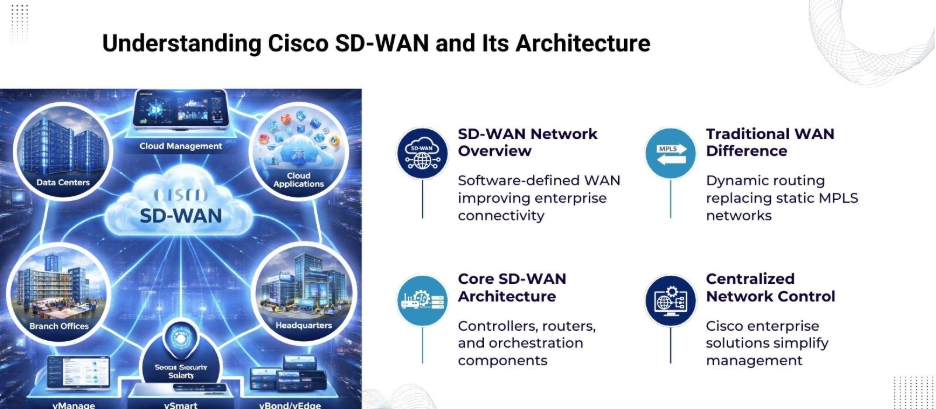
Cisco SD-WAN is a cloud-delivered WAN architecture that simplifies branch connectivity, enhances security, and improves application performance. Unlike traditional WANs that rely heavily on hardware and fixed MPLS circuits, SD-WAN uses software-defined policies to direct traffic over a combination of MPLS, broadband, and LTE connections. This flexibility allows enterprises to reduce operational costs while delivering consistent network experiences.
Key components of Cisco SD-WAN include:
- vEdge Routers and ISRs – These devices connect branch offices to the SD-WAN overlay network.
- vSmart Controllers – They manage control plane functions, including policies and route distribution.
- vManage – A centralized management platform that provides monitoring, configuration, and reporting.
- vBond Orchestrator – Facilitates secure onboarding of new devices into the network.
By integrating these components, Cisco enterprise networking solutions provide centralized control, advanced analytics, and automation capabilities that traditional networks often lack.
Benefits of Cisco SD-WAN for Growing Enterprises
Growing enterprises face unique networking challenges, like multiple branch locations, cloud adoption, and increasing security threats. Cisco SD-WAN addresses these challenges effectively.
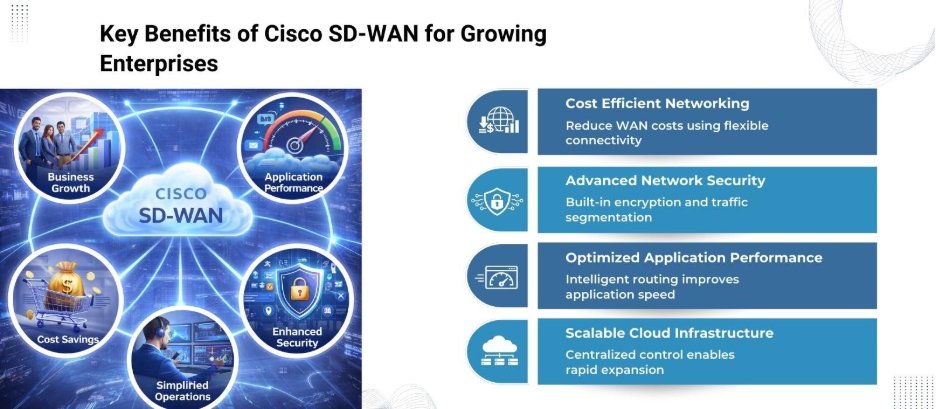
1. Cost-Effective Network Management
Traditional WANs depend on expensive MPLS links, which can quickly escalate in cost as the enterprise expands. On the contrary, Cisco SD-WAN allows businesses to leverage broadband and LTE links alongside MPLS, which significantly reduces network costs. Additionally, the centralized management offered by Cisco enterprise networking solutions reduces the need for on-site IT staff at every branch.
2. Enhanced Network Security
Security is a top priority for growing enterprises. Therefore, Cisco SD-WAN comes with integrated security features, such as:
- End-to-end encryption for data in transit
- Segmentation of traffic to prevent unauthorized access
- Built-in firewall and intrusion prevention capabilities
These security measures help enterprises maintain data integrity, comply with regulations, and protect sensitive information across distributed locations.
3. Optimized Application Performance
One of the most compelling advantages of Cisco SD-WAN is its ability to prioritize traffic based on application type and business importance. Critical applications like ERP systems, VoIP, and cloud-based tools can be given higher priority, while less critical traffic uses available bandwidth efficiently. This application-aware routing improves performance, reduces latency, and supports a seamless user experience.
4. Scalability and Flexibility
Growing enterprises often face changing network requirements. That’s why Cisco SD-WAN enables rapid deployment of new sites without the need for extensive on-site configurations. By using cloud-managed Cisco enterprise networking solutions, enterprises can expand their network coverage with minimal disruption and adapt quickly to market demands.
5. Centralized Management and Automation
Managing multiple network locations can be complex and time-consuming. Therefore, Cisco SD-WAN offers a centralized dashboard through vManage, providing visibility into network health, traffic patterns, and potential issues. Likewise, automation tools enable configuration templates, policy enforcement, and updates across all branches simultaneously. This reduces human error and frees IT teams to focus on strategic initiatives rather than routine maintenance.
6. Cloud-Ready Infrastructure
As enterprises increasingly adopt cloud applications and services, network architectures must support efficient cloud connectivity. Cisco SD-WAN provides direct, secure access to cloud services, which reduces latency and improves application performance. As a result, enterprises can route traffic intelligently to avoid bottlenecks at the data center and improve the overall cloud experience.
Key Features of Cisco SD-WAN
To summarize the advantages, here’s a table highlighting the key features of Cisco SD-WAN for growing enterprises:
| Feature | Description | Benefit for Growing Enterprises |
| Centralized Management | vManage dashboard offers full visibility and configuration | Simplifies network administration across multiple sites |
| Intelligent Path Control | Directs traffic based on application type and network conditions | Optimizes performance and reduces latency |
| Integrated Security | Includes encryption, segmentation, firewall, and IPS | Protects sensitive data and supports compliance |
| Cloud Connectivity | Direct access to SaaS and cloud applications | Enhances cloud application performance |
| Cost Optimization | Combines MPLS, broadband, and LTE | Reduces WAN costs while maintaining performance |
| Scalability | Rapid deployment of new sites without on-site IT | Supports enterprise growth and expansion |
| Analytics and Reporting | Detailed insights into traffic and network health | Enables proactive maintenance and strategic planning |
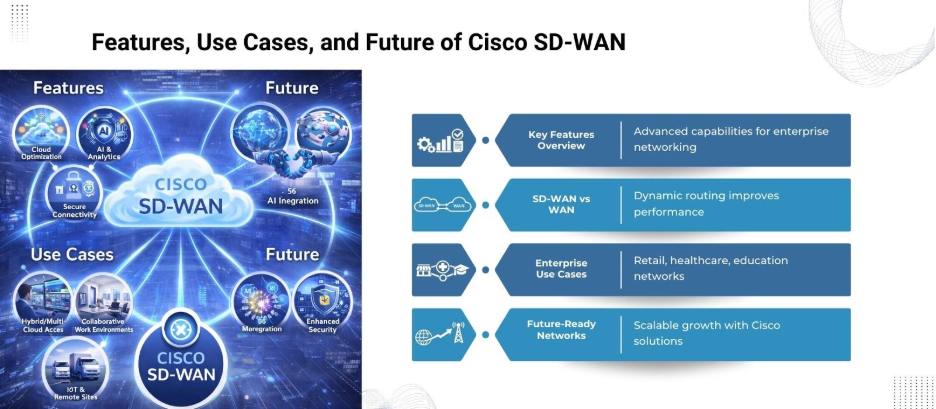
Cisco SD-WAN vs. Traditional WAN
To understand the value proposition, it is helpful to compare Cisco SD-WAN with traditional WAN:
- Traditional WAN: Relies on static MPLS links, manual configurations, and hardware-centric policies. Performance issues at a single link can affect the entire network.
- Cisco SD-WAN: Uses dynamic routing over multiple links, centralized policy management, and cloud integration. It offers high availability, reduced downtime, and better bandwidth utilization.
For growing enterprises, these differences translate to measurable benefits: faster deployments, lower costs, improved application performance, and enhanced security.
Real-World Use Cases
Cisco SD-WAN supports a wide range of enterprise scenarios:
- Multi-Branch Enterprises: Companies with offices across cities or countries can manage all locations from a single console.
- Retail Chains: Retail businesses can prioritize point-of-sale traffic and provide secure, fast connectivity to cloud-based inventory systems.
- Healthcare Organizations: Hospitals and clinics can secure patient data and maintain reliable connectivity for telemedicine and electronic health records.
- Educational Institutions: By streamlining multi-campus operations, schools can maintain high-performance internet access and segment network traffic to safeguard sensitive data.
In each scenario, the agility, security, and centralized management of Cisco SD-WAN demonstrate tangible benefits that traditional WAN cannot match.
Future-Proofing Networks with Cisco SD-WAN
As technology evolves, enterprises need network infrastructures that can adapt to new demands, including IoT devices, cloud migration, and hybrid work models. Cisco SD-WAN provides the foundation for a future-ready network. By adopting Cisco enterprise networking solutions, businesses gain the flexibility to integrate emerging technologies, maintain high performance, and expand without major overhauls.
By choosing Nurture IT in Indiranagar, you’re unlocking a partnership with trusted Cisco enterprise networking solutions. Our experts guide you at every step, from planning and deployment to maintenance and upgrades, helping your business stay competitive in an increasingly digital world. Contact us today!
FAQs
1. How does Cisco SD-WAN improve network performance for enterprises?
Cisco SD-WAN uses intelligent path control to route application traffic based on network conditions. This capability enables enterprises to prioritize business-critical applications such as VoIP, CRM, and cloud platforms for better speed and reliability.
2. Why are Cisco enterprise networking solutions important for growing enterprises?
Cisco enterprise networking solutions provide scalable infrastructure, centralized management, and integrated security. These capabilities help growing enterprises manage multiple branches, support cloud adoption, and maintain stable connectivity across distributed locations.
3. What security features are included in Cisco SD-WAN?
Cisco SD-WAN includes encryption, segmentation, integrated firewalls, and intrusion prevention systems. These features help organizations protect sensitive data while maintaining secure connectivity across networks.
4. What industries benefit most from Cisco enterprise networking solutions?
Industries such as retail, healthcare, education, finance, and manufacturing benefit from Cisco enterprise networking solutions because they require secure, reliable, and scalable network connectivity across multiple locations.