Inside Cisco Network Security Solutions: How Enterprises Are Building Zero-Trust Networks
Cybersecurity has entered a new phase. Today, perimeter-based protection models and traditional firewalls no longer match the way modern enterprises operate. Employees work remotely, applications run across multiple clouds, IoT devices constantly connect to networks, and AI-driven workloads create entirely new attack surfaces.
That shift is exactly why Zero Trust Architecture has become one of the biggest cybersecurity movements worldwide.
Instead of assuming that users or devices inside a network are trustworthy, Zero Trust follows one core principle: trust nothing, verify everything continuously.
This is where Cisco has become a key player. Modern enterprises are increasingly adopting Cisco network security solutions to build scalable Zero Trust environments that protect users, applications, devices, and data across hybrid infrastructures.
Why Enterprises Are Moving Away From Traditional Security Models
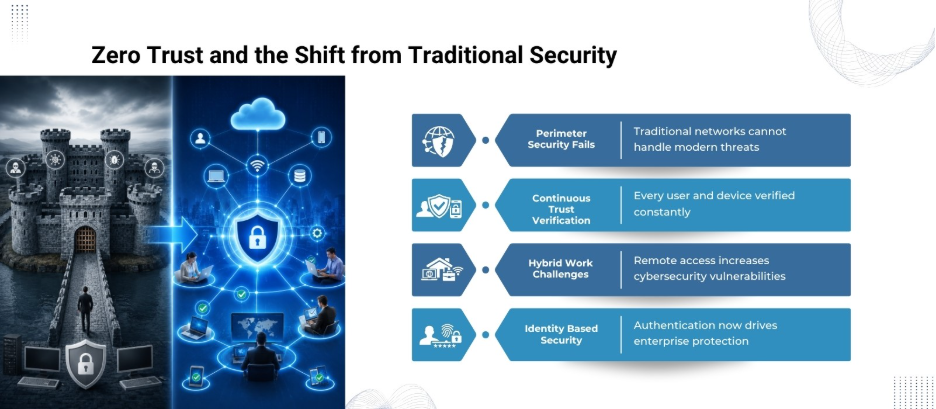
For years, enterprise security worked like a castle-and-moat system. Once a user entered the network, they often gained broad access to internal systems.
However, that model struggles today because:
- Hybrid workforces connect from anywhere
- Cloud applications exist outside corporate perimeters
- IoT devices continuously communicate with enterprise systems
- Cyberattacks increasingly target identities instead of networks
- AI tools and automation create new vulnerabilities
Modern attackers no longer need to “break into” a network physically. Stolen credentials, compromised devices, phishing campaigns, and unsecured APIs can provide direct access.
Zero Trust changes this approach completely.
Every login request, device, application, and session gets verified repeatedly using identity, context, behavior, and risk analysis.
What Is Zero Trust Architecture?
Zero Trust Architecture (ZTA) is a cybersecurity framework based on continuous authentication and least-privileged access.
Instead of granting broad permissions, Zero Trust allows users to access only the specific resources they need.
A Zero Trust environment usually includes:
| Zero Trust Component | Purpose | Cisco Solution Example |
| Identity Verification | Confirms user identity continuously | Cisco Duo |
| Secure Access | Grants controlled application access | Cisco Secure Access |
| Network Segmentation | Limits lateral movement inside networks | Cisco Secure Firewall |
| Threat Detection | Detects suspicious behavior in real time | Cisco XDR |
| Device Trust | Validates endpoint health and compliance | Cisco Identity Services Engine (ISE) |
| Cloud Security | Protects SaaS and cloud environments | Cisco Umbrella |
These layers work together to create a security model where every interaction is monitored dynamically.
How Cisco Network Security Solutions Support Zero Trust
Cisco has spent the last few years expanding its security ecosystem around Zero Trust principles.
The company now integrates networking, identity security, cloud protection, endpoint monitoring, and threat intelligence into a unified architecture.
Here are some of the most important Cisco network security solutions enterprises are adopting right now.
Cisco Secure Access
Cisco Secure Access is one of Cisco’s most important Zero Trust platforms.
It operates as a cloud-delivered Security Service Edge (SSE) solution built around Zero Trust Network Access (ZTNA).
Cisco Secure Access provides:
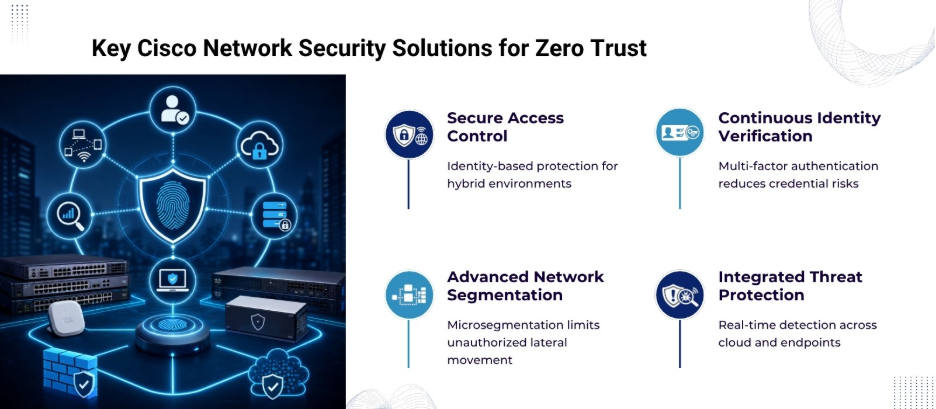
- Identity-aware access control
- Secure web gateway capabilities
- Cloud Access Security Broker (CASB)
- Firewall-as-a-Service (FWaaS)
- DNS-layer protection
- Remote browser isolation
Instead of exposing entire networks through VPNs, the platform grants access only to authorized applications and workloads.
This represents a major shift away from traditional VPN-based security.
Cisco Duo and Identity-Centric Security
Identity has become the new security perimeter.
That is why Cisco Duo plays an important role in Zero Trust deployments.
Multi-factor authentication (MFA), adaptive authentication, and device trust validation help organizations reduce risks from compromised credentials.
Duo verifies:
- User identity
- Device health
- Login behavior
- Geographic anomalies
- Risk signals
This matters because credential theft remains one of the most common attack vectors in enterprise environments.
Modern Zero Trust strategies focus heavily on continuous identity validation rather than one-time authentication.
Industry experts increasingly describe this shift as moving from “identity verification” toward “behavior verification.”
Cisco Identity Services Engine (ISE)
Cisco ISE helps enterprises implement policy-based access control across networks.
It identifies users, endpoints, and devices attempting to connect to the enterprise infrastructure.
Once identified, organizations can:
- Restrict unauthorized devices
- Segment network traffic
- Apply role-based access policies
- Automate compliance enforcement
This becomes especially important in environments filled with IoT devices, operational technology systems, and unmanaged endpoints.
Without segmentation, attackers can move laterally across networks after compromising a single device.
Microsegmentation and Secure Firewalls
One of the biggest Zero Trust principles is microsegmentation.
Instead of operating large flat networks, enterprises divide infrastructure into smaller protected zones.
Cisco Secure Firewall supports this approach through:
- Granular policy enforcement
- Application-aware filtering
- Threat intelligence integration
- Encrypted traffic inspection
- Zero Trust application access
Cisco’s newer firewall capabilities even support browser-based Zero Trust access for applications.
This reduces exposure significantly because users interact only with specific authorized applications rather than entire internal networks.
AI and the Future of Zero Trust
The next major cybersecurity challenge involves AI agents and non-human identities.
Enterprises are rapidly adopting autonomous AI systems that access APIs, enterprise databases, SaaS applications, and internal tools.
Cisco recently expanded its Zero Trust strategy to address these risks.
The company now emphasizes:
- Identity governance for AI agents
- Behavioral monitoring
- API trust management
- Non-human identity protection
- Continuous authorization models
This trend is becoming increasingly important because AI-driven automation can operate at machine speed, which makes traditional manual monitoring ineffective.
Zero Trust models are evolving beyond human authentication into machine-to-machine trust verification.
Why Enterprises Prefer Cisco’s Integrated Approach
One reason Cisco network security solutions continue gaining momentum is integration.
Many enterprises struggle with fragmented security stacks that combine products from multiple vendors.
Cisco attempts to unify:
- Networking
- Security
- Identity management
- Cloud protection
- Endpoint visibility
- Threat detection
That unified model simplifies policy management and improves visibility across hybrid infrastructures.
Cisco also integrates Zero Trust principles directly into networking architecture rather than treating security as a separate layer.
This approach becomes especially valuable for enterprises managing:
- Remote workforces
- Multi-cloud systems
- Branch offices
- IoT environments
- Hybrid applications
Zero Trust Is Becoming a Long-Term Strategy
Zero Trust is no longer viewed as a temporary cybersecurity trend.
Governments, financial institutions, healthcare providers, manufacturing companies, and technology enterprises increasingly consider it a long-term security model.
The rise of:
- Hybrid work
- Cloud-native infrastructure
- AI-driven automation
- API ecosystems
- IoT devices
- Ransomware attacks
has permanently changed enterprise security requirements.
Cisco’s continued investment in Secure Access, identity intelligence, AI protection, and integrated threat detection shows how central Zero Trust has become to enterprise networking strategies.
Why Businesses Trust Nurture IT for Cisco Network Security Solutions
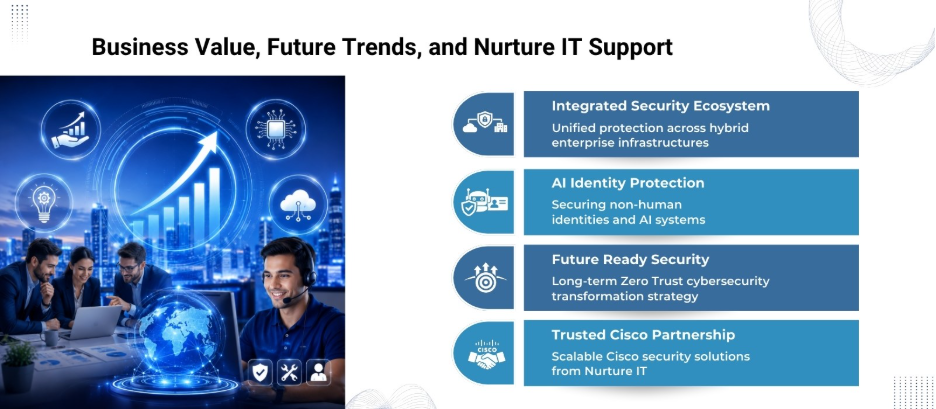
At Nurture IT, we help businesses build smarter, more secure IT environments with advanced Cisco network security solutions. As an official Cisco dealer in Indiranagar, Bangalore, we provide end-to-end support for Cisco security technologies, including firewalls, secure networking, endpoint protection, cloud security, and Zero Trust access solutions.
Our team works closely with organizations to understand their infrastructure, identify security gaps, and recommend scalable Cisco solutions that align with business goals. Whether you are upgrading your enterprise network, securing remote workforces, or adopting Zero Trust strategies, we bring the expertise and trusted Cisco technologies needed to strengthen your cybersecurity posture.
Final Thoughts
The cybersecurity landscape now revolves around continuous trust validation rather than static perimeter defense. From Cisco Secure Access and Duo to ISE and Secure Firewall technologies, their ecosystem reflects the broader transformation happening across enterprise cybersecurity.
Organizations that begin building Zero Trust foundations today will likely adapt faster to tomorrow’s cybersecurity threats. Therefore, your secure digital transformation starts with the right partner — and Nurture IT is ready to help.
FAQs
1. What is Zero Trust Architecture?
Zero Trust Architecture is a cybersecurity model based on the principle of “never trust, always verify.” It continuously validates users, devices, and applications before granting access to enterprise resources.
2. Why are enterprises adopting Zero Trust security models?
Enterprises are adopting Zero Trust because traditional perimeter-based security models struggle to protect hybrid workforces, cloud environments, remote users, and IoT devices from modern cyberattacks.
3. How does Cisco Duo support Zero Trust?
Cisco Duo supports Zero Trust through multi-factor authentication, device trust verification, adaptive access policies, and continuous identity validation.
4. What is Cisco Secure Access?
Cisco Secure Access is a cloud-delivered security platform that provides Zero Trust Network Access (ZTNA), secure web gateway capabilities, firewall protection, and cloud security features.
5. How does microsegmentation improve network security?
Microsegmentation divides enterprise networks into smaller protected zones, limiting lateral movement for attackers and improving access control across systems.