
IT Service Provider vs MSP: What’s the Difference for a Growing Business?
For a growing business, IT problems rarely stay confined to the IT department. A network outage can stop sales. An unpatched laptop can create a security risk. Poorly planned infrastructure can make expansion unnecessarily expensive.
This is why choosing between an IT service provider and a Managed Service Provider (MSP) matters. The two terms are often used interchangeably, but they describe different approaches to technology support.
The important question is not simply, “Which one costs less?” It is: Which operating model fits the way your business is growing?
IT Service Provider vs MSP: The Core Difference
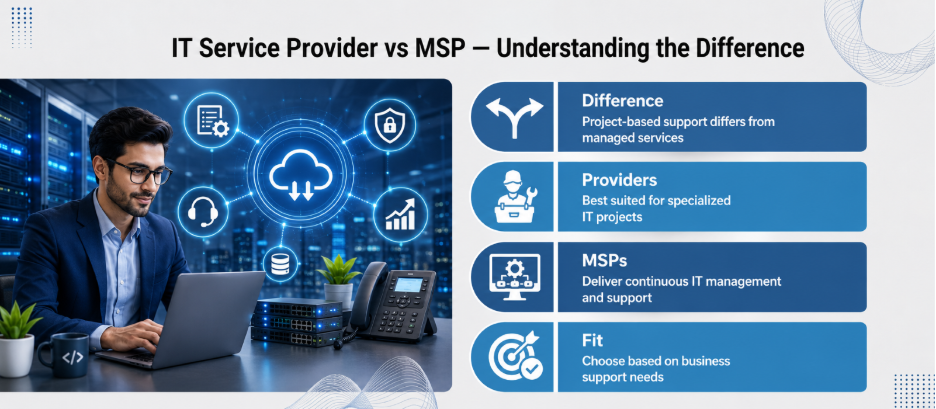
An IT service provider is a broad category. It can include companies that provide hardware, software, networking, cybersecurity, cloud implementation, consulting, technical support, or project-based IT services.
MSPs are a specific type of IT provider built around ongoing management and support. An MSP typically takes responsibility for defined parts under a recurring service arrangement. Services can include monitoring, help desk support, network management, endpoint management, maintenance, and security operations.
The distinction is useful because the commercial relationship can be very different.
A traditional provider might be called when you need a server installed, office networking redesigned, employees equipped with laptops, or a cloud migration completed. An MSP is more likely to stay involved after implementation and manage the environment continuously.
Where IT Service Providers Make More Sense?
Project-based IT support can be the better option when your technology requirements are occasional or highly specialised.
Imagine a 40-person company opening a second office. It may need:
- Network design and installation
- Firewall deployment
- New laptops and peripherals
- Server configuration
- Cloud migration
- Security assessment
The company may not need someone managing every part of its IT environment every month. Thus, a specialist provider can complete the project and hand ongoing responsibility back to the internal team.
This model can also work well when you already have capable IT employees but need outside expertise for a particular challenge.
That is one reason businesses should not automatically assume that a managed contract is the best answer.
Where an MSP Changes the Equation?
An MSP becomes more compelling when IT becomes too complicated to manage. Consider a growing company with 100 employees, multiple locations, cloud applications, remote workers, business-critical data, and increasingly complex cybersecurity requirements.
But waiting for employees to report every technical problem creates a reactive IT model. An MSP can instead provide ongoing monitoring and defined support processes.
Common MSP responsibilities include:
- Help desk and user support
- Endpoint and device management
- Network monitoring
- Server administration
- Backup management
- Patch and maintenance activities
- Cybersecurity services
- Cloud and infrastructure management
- IT asset management
MSPs commonly provide remote management of customer IT and end-user systems and can also help organizations scale IT capabilities. For smaller businesses, this can effectively create an external IT function without replicating the entire cost structure of a large internal department.
The Cost Question Is More Complicated Than It Looks
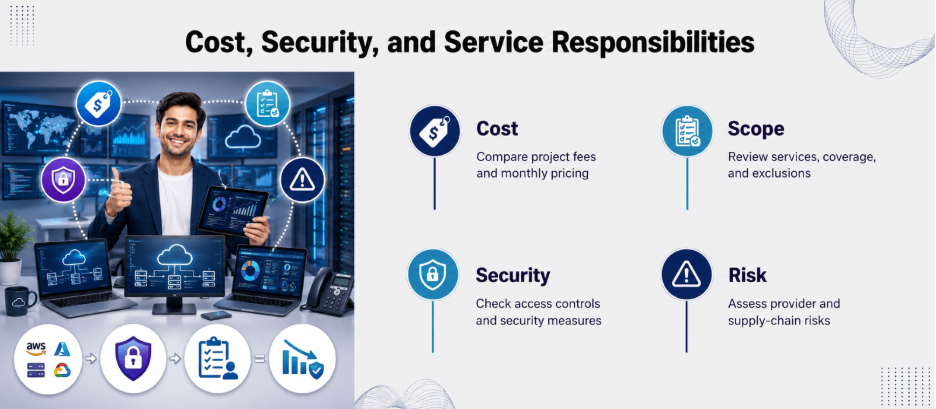
Comparing an IT project quote against a monthly fee can produce a misleading conclusion.
A project-based provider may look cheaper because you pay only when a specific requirement arises. But that does not account for internal employee time, unexpected outages, maintenance, security tooling, or specialist expertise that may be required later.
An MSP typically uses a recurring commercial model. That makes ongoing IT expenditure easier to forecast, although the actual value depends heavily on what the contract covers.
Before comparing prices, ask:
What is included?
A low monthly fee may cover only help desk support. Another package could include monitoring, endpoint management, backup administration, cybersecurity tools, and on-site support.
Compare the scope, response commitments, exclusions, escalation process, and after-hours coverage — not just the monthly number.
The Security Difference Businesses Often Miss
Outsourcing IT does not automatically make a business more secure.
In fact, an MSP can become a big part of your security and supply-chain risk because providers may have privileged access to customer systems.
CISA recommends that organizations assess MSP-related supply-chain risk, apply least-privilege access, monitor provider activity, and address security responsibilities contractually.
So when evaluating IT service provider companies, ask practical questions:
- How is privileged access controlled?
- Is MFA required for administrative accounts?
- Are provider activities logged?
- Who can access backups?
- How quickly are security incidents communicated?
- What happens to accounts when an employee leaves the provider?
- What happens to your data and credentials when the contract ends?
These questions are often more valuable than asking whether a provider simply “offers cybersecurity.”
What Growing Businesses Should Look for in IT Service Provider Companies?
Growth changes IT requirements quickly. A company that has 25 employees today may have 100 in two years.
That means your provider should be evaluated for operational fit, not just technical capability.
Therefore, look for:
1. A Clearly Defined Service Scope
Know exactly which systems the provider manages and which remain your responsibility.
2. Measurable Service Commitments
Look for documented response and resolution processes. Ask how incidents are prioritised and escalated.
3. Scalability
Adding employees should not require rebuilding your entire IT operating model.
4. Security Controls
Review MFA, privileged access, logging, endpoint protection, backup practices, and incident response responsibilities.
5. Reporting
Good reporting should help management understand recurring incidents, asset status, service performance, and technology risks.
6. Strategic Capability
As your business grows, IT decisions become business decisions. Your provider should be able to discuss infrastructure, security, cloud, asset lifecycle, and technology planning — not just troubleshoot laptops.
For businesses exploring IT service providers in Bangalore, local availability can also matter when on-site support, hardware deployment, networking, or office expansion is part of the requirement.
IT Service Provider or MSP: Which One Should You Choose?
There is no universal winner.
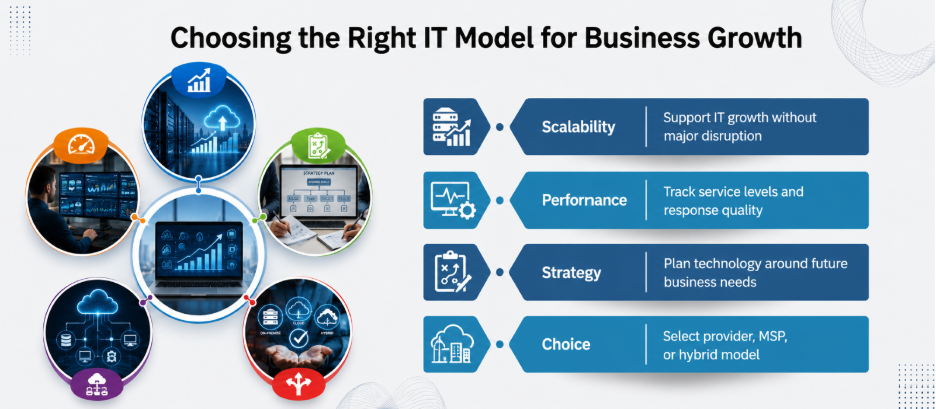
Choose a traditional or project-focused provider when you have a defined technology project, strong internal IT capabilities, or a need for specialised expertise.
Consider an MSP when IT requires continuous attention, your internal team is stretched, downtime has a measurable business impact, or you need broader access to technical expertise without building every capability internally.
There is also a third option: hybrid IT.
Your internal team can retain strategic ownership while an external provider manages selected operational areas like endpoints, infrastructure, backup, networking, or help desk support.
For many growing businesses, that is the most practical model. IT solutions for small and medium businesses discuss how managed IT services can fit the needs of SMBs, including support, maintenance, networking, and scalable service packages.
The Bottom Line
The real difference between an IT service provider and an MSP is not simply the list of technologies they support. It is how responsibility is structured.
An IT service provider can help you solve a specific technology requirement. An MSP can take continuing responsibility for defined parts of your IT environment.
Do not buy “managed IT” simply because it sounds proactive. Define the outcomes you need first. Then select the provider model that can deliver them with clear responsibilities, measurable service levels, strong security controls, and room to scale.
Talk to the Nurture IT team to assess your current setup and identify the right approach.
FAQs
1. Is an MSP the same as an IT service provider?
No. MSP is a specific type of IT service provider focused primarily on ongoing management and support. “IT service provider” is a broader term covering project, consulting, support, infrastructure, cloud, security, and other IT services.
2. Is an MSP suitable for a small business?
It can be. MSPs can give small businesses access to technical expertise and ongoing IT management without requiring the company to build a large internal IT department.
3. Are MSP services usually charged monthly?
Many MSPs use recurring subscription or contract-based pricing, although pricing models vary. Some providers also offer project-based services separately.
4. Can an MSP replace an internal IT team?
Sometimes, but not always. The right model depends on company size, complexity, internal expertise, regulatory requirements, and the level of control the business wants to retain.
5. What should I ask an MSP before signing a contract?
Ask about service scope, response commitments, security controls, privileged access, backup responsibilities, reporting, escalation, contract termination, and what happens to your data and accounts when the relationship ends.