Server Virtualization: Why Businesses Rely on IT Infrastructure Providers
Modern enterprises operate in an environment where agility, scalability, and cost efficiency define success. However, traditional server setups, built around physical, single-purpose machines, struggle to meet dynamic business demands. This is where server virtualization becomes a foundational technology, transforming how organizations deploy, manage, and scale IT resources.
As virtualization environments grow more complex, businesses increasingly depend on an IT infrastructure service provider to design, implement, and manage virtualized ecosystems that support performance, security, and long-term growth.
What Is Server Virtualization?
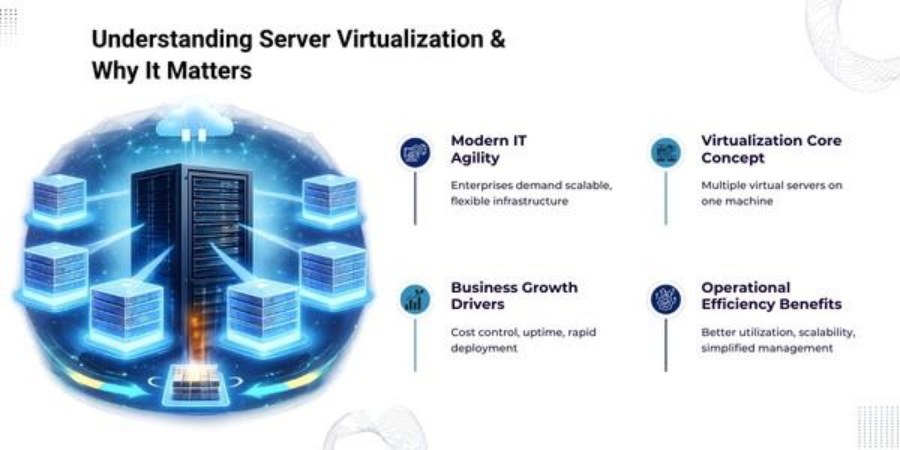
Server virtualization is a technology that allows multiple virtual servers (also known as virtual machines or VMs) to run on a single physical server. A software layer called a hypervisor separates the hardware from the operating systems, allowing each virtual server to function independently.
Instead of dedicating one physical server to one application, organizations can run multiple workloads on the same hardware without interference. This approach significantly improves resource utilization and operational efficiency.
Why Server Virtualization Is a Business Priority
Server virtualization is no longer limited to large enterprises. Small and mid-sized businesses also adopt virtualization to remain competitive and cost-effective.
Key Business Drivers Behind Virtualization
- Rising infrastructure costs
- Growing demand for uptime and performance
- Rapid expansion of cloud and hybrid environments
- Increased focus on disaster recovery and business continuity
- Need for faster deployment of applications and services
An experienced IT infrastructure service provider helps organizations align virtualization strategies with these business objectives.
Role of an IT Infrastructure Service Provider in Server Virtualization
Implementing server virtualization involves far more than installing hypervisor software. It requires careful planning, performance analysis, security configuration, and ongoing optimization.
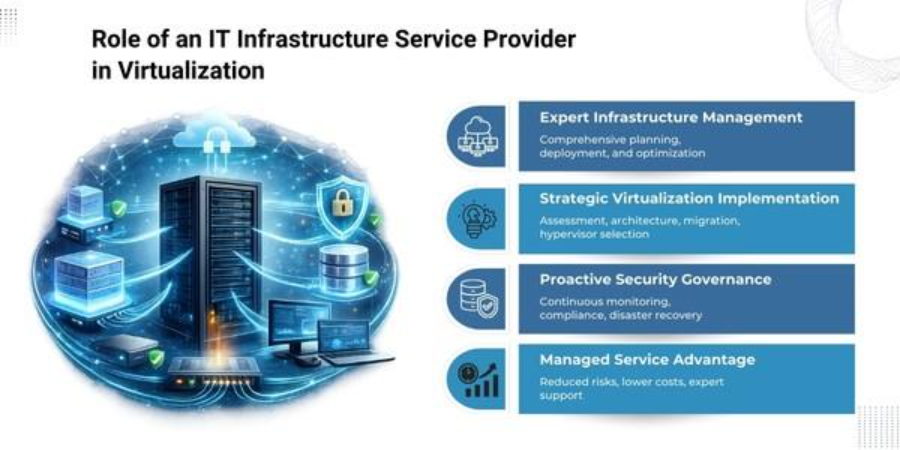
An IT infrastructure service provider brings technical expertise and industry experience to manage these complexities.
Core Responsibilities Include:
- Assessing existing infrastructure and workloads
- Designing virtual server architectures
- Selecting suitable hypervisors and storage models
- Managing migration from physical to virtual servers
- Monitoring performance and capacity
- Applying security and compliance controls
- Supporting disaster recovery and backup strategies
Benefits of Server Virtualization for Businesses
1. Improved Hardware Utilization
Traditional servers often operate at less than 20% capacity. Virtualization allows businesses to maximize CPU, memory, and storage usage by consolidating workloads on fewer machines.
2. Cost Optimization
By reducing the number of physical servers, organizations lower expenses related to:
- Hardware procurement
- Power and cooling
- Data center space
- Maintenance and upgrades
An IT infrastructure service provider helps calculate ROI and prevent over-provisioning.
3. Faster Deployment and Scalability
Virtual servers can be provisioned in minutes instead of weeks. Businesses can scale resources up or down based on demand, supporting growth without infrastructure bottlenecks.
4. Enhanced Business Continuity
Virtualization simplifies backup, replication, and recovery processes. Virtual machines can be restored or migrated across hosts with minimal downtime, supporting high availability requirements.
5. Simplified IT Management
Centralized management tools allow administrators to monitor and control multiple virtual servers from a single interface, reducing operational complexity.
Server Virtualization Models Explained
| Virtualization Model | Description | Best Use Case |
| Full Virtualization | Each VM runs its own OS with complete hardware abstraction | Mixed workloads and legacy applications |
| Para-Virtualization | Guest OS interacts directly with the hypervisor | Performance-sensitive environments |
| OS-Level Virtualization | Containers share a single OS kernel | Microservices and cloud-native applications |
| Hybrid Virtualization | Combines on-premise and cloud virtual servers | Organizations transitioning to cloud |
An IT infrastructure service provider helps organizations select the right model based on performance, compliance, and scalability needs.
Security Considerations in Virtualized Environments
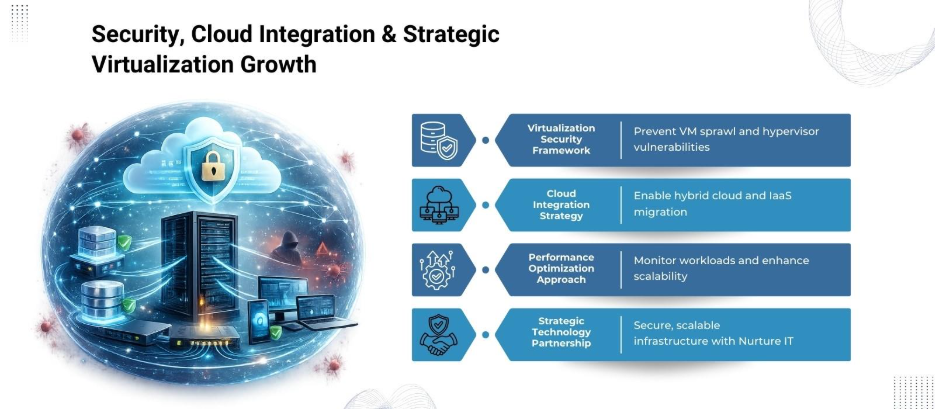
Virtualization introduces unique security challenges that require specialized expertise.
Common Security Concerns:
- VM sprawl and misconfigurations
- Hypervisor vulnerabilities
- Insecure VM snapshots and backups
- Improper access controls
- Network segmentation gaps
As a result, professional IT infrastructure service providers apply security best practices such as:
- Role-based access control
- Network micro-segmentation
- Regular vulnerability assessments
- Secure VM lifecycle management
- Continuous monitoring and logging
Server Virtualization and Cloud Integration
Server virtualization is the backbone of cloud computing. Most public, private, and hybrid cloud platforms rely on virtualization to deliver flexible, on-demand resources.
Businesses often work with an IT infrastructure service provider to:
- Integrate on-premise virtual servers with cloud platforms
- Build hybrid cloud architectures
- Migrate workloads to Infrastructure-as-a-Service (IaaS)
- Optimize performance across environments
This approach supports digital transformation without disrupting existing operations.
Why Businesses Choose Managed Virtualization Services
Many organizations prefer managed virtualization services over in-house management due to skill gaps and operational overhead.
Advantages of Managed Services:
- Access to certified virtualization experts
- Proactive monitoring and performance tuning
- Predictable operational costs
- Reduced downtime and faster issue resolution
- Strategic guidance for future expansion
A trusted IT infrastructure service provider becomes a long-term technology partner rather than just a vendor.
How Nurture IT Supports Modern Server Virtualization
Nurture IT, a trusted IT infrastructure service provider in Indiranagar, helps organizations design, deploy, and manage virtualization frameworks that align with both technical requirements and business goals.
With hands-on expertise across leading virtualization platforms, Nurture IT supports enterprises at every stage of their virtualization journey — from assessing legacy infrastructure and planning physical-to-virtual migrations to optimizing performance in hybrid and cloud-integrated environments.
What sets Nurture IT apart is our consultative mindset. Instead of one-size-fits-all deployments, our team evaluates workload behavior, compliance needs, and future growth plans before recommending virtualization architectures. This allows organizations to extract long-term value from their infrastructure investments while maintaining performance and security across virtual servers.
For businesses looking to strengthen uptime, improve resource utilization, and modernize IT operations, partnering with Nurture IT brings both technical depth and strategic insight to server virtualization initiatives.
Final Thoughts
Server virtualization has become a strategic pillar for businesses aiming to improve agility, control infrastructure costs, and support evolving digital workloads. However, long-term success depends on thoughtful architecture, ongoing optimization, and strong security practices. This is where working with an experienced IT infrastructure service provider makes a measurable difference.
Partner with Nurture IT to build a scalable, secure, and performance-driven virtualization environment that supports your business today and tomorrow.
FAQs
1. What is server virtualization in simple terms?
Server virtualization allows multiple virtual servers to run on a single physical server using a hypervisor, improving resource efficiency.
2. Why do businesses need an IT infrastructure service provider for virtualization?
An IT infrastructure service provider offers expertise in design, deployment, security, and optimization of virtual environments.
3. How does server virtualization reduce IT costs?
It lowers hardware, power, cooling, and maintenance expenses by consolidating workloads onto fewer physical servers.
4. Is server virtualization suitable for small businesses?
Yes, virtualization helps small businesses scale resources efficiently without large upfront infrastructure investments.
5. Are virtual servers secure?
Virtual servers are secure when configured correctly, with proper access controls, monitoring, and network segmentation.