
Understanding Refurbished Grading (Grade A, B, C): What You Actually Get for Your Money
When you see a refurbished laptop listed as Grade A, Grade B, or Grade C, it is easy to assume the letters tell you how good the laptop is.
They don’t tell the whole story.
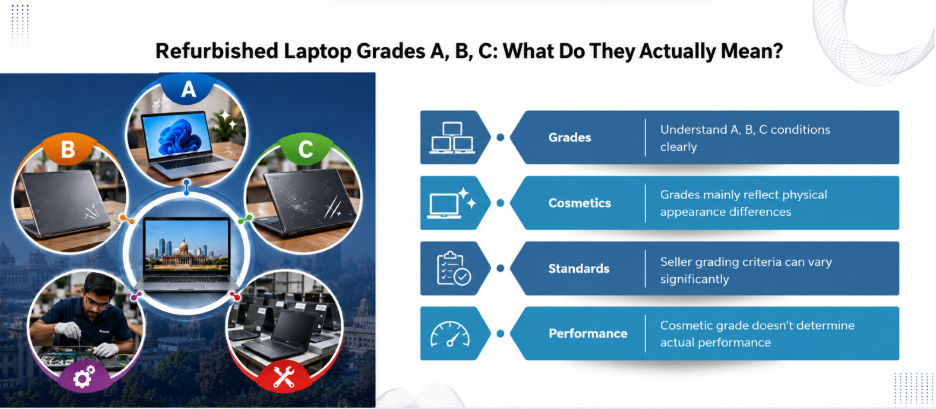
In most cases, refurbished grades primarily describe the cosmetic condition of a previously owned device. They do not automatically tell you the performance, battery health, remaining lifespan, repair history, or quality of the refurbishment. More importantly, there is no universal industry-wide definition for Grade A, B, and C.
So, if you’re comparing refurbished laptops Bangalore, don’t stop at the grade printed on the listing. Look at what you’re actually getting for your money.
What Does Grade A Mean?
A Grade A refurbished laptop comes closest to looking brand new among pre-owned machines. You can typically expect:
- Very light or minimal visible scratches
- Little evidence of previous use
- A clean exterior
- A display without obvious cosmetic damage
- A fully functional system, assuming the seller’s grading policy requires functional testing
However, Grade A does not mean “new.” It may have an older battery or components that have already accumulated usage.
This is where buyers sometimes make a costly mistake. A Grade A label can make an older laptop sound more attractive than its specifications actually are.
For example, a five-year-old Grade A laptop is still a five-year-old laptop. A newer machine with a less attractive cosmetic grade could potentially have a more relevant processor, newer connectivity standards, and a longer remaining useful life.
What Does Grade B Mean?
Grade B usually indicates moderate or normal signs of previous use.
That could include:
- Light scratches or scuffs
- Small marks on the lid or palm rest
- Minor cosmetic imperfections
- Signs of regular handling
The important distinction is that cosmetic Grade B does not inherently mean poor performance. A properly refurbished Grade B laptop can function perfectly well. However, you cannot assume this from the letter alone.
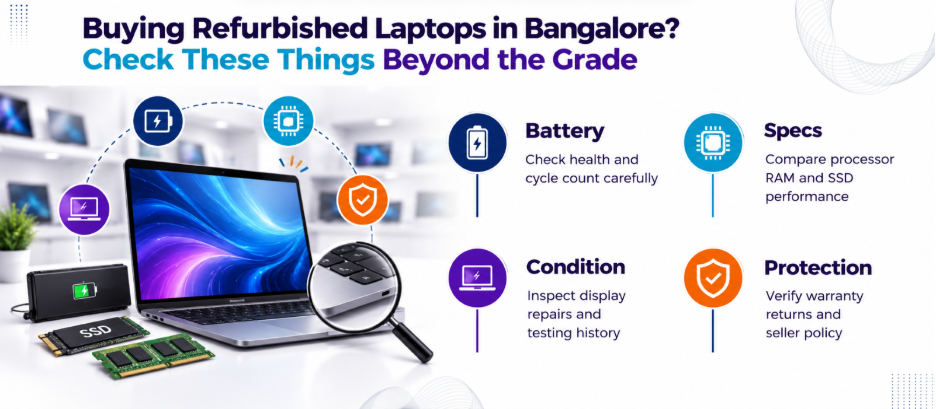
Therefore, ask the seller what was tested, whether the battery was assessed, whether the SSD was checked, whether the display has dead pixels, and whether any components were replaced.
What Does Grade C Mean?
Grade C normally represents more visible cosmetic wear.
You may see:
- Noticeable scratches
- Scuffs
- Small dents
- Marks from prolonged use
- More obvious signs of previous ownership
A Grade C laptop can be perfectly usable if it has been properly tested and the seller clearly discloses its condition.
However, the bigger question is whether the saving is large enough to justify buying an older, visibly worn device.
The Battery Is More Important Than the Grade
Here’s something many buyers overlook.
A laptop’s cosmetic condition tells you very little about its battery’s remaining capacity.
Lithium-ion batteries naturally lose capacity over time and usage. Therefore, a refurbished laptop that looks almost new can still have a battery that has already gone through substantial use.
Ask for:
- Battery health or capacity information
- Battery cycle information, where available
- Whether the battery has been replaced
- The warranty coverage for the battery
- Expected battery runtime under normal use
Battery condition becomes especially important if you travel frequently or work away from a power outlet. You may go through our guide on laptop battery charging and battery longevity.
Don’t Let a High Grade Distract You From the Specifications
Imagine you have two choices:
Laptop A: Grade A, older processor, 8GB RAM and a smaller SSD.
Laptop B: Grade C, newer processor, 16GB RAM and a larger SSD.
If Laptop B has been properly tested, has acceptable battery health, and comes with appropriate warranty protection, its visible scratches may be less important than the hardware inside.
The grade should therefore be treated as one buying factor, not the buying decision.

Refurbished vs New: Which Gives You More for Your Money?
This is where the conversation becomes more interesting.
A refurbished laptop can offer an attractive specification at a lower upfront price. That can make sense if your budget is tight. But a new laptop has some practical advantages that a refurbished grading system cannot provide.
With a new laptop, you generally know:
- It has not previously been used by another owner
- The battery starts essentially from new
- The device has no undisclosed wear from previous use
- You are buying current-generation or recently released hardware
- The manufacturer’s original warranty terms apply according to the product
- You have a clearer product history
Manufacturer-certified refurbished products can also come with meaningful testing and warranty protection. For example, Dell describes its certified refurbished systems as previously owned products that undergo a refurbishment process and are backed by limited warranty coverage.
But third-party refurbished products can vary considerably depending on the seller.
That distinction matters.
When Does Buying New Make More Sense?
For many buyers, a new laptop is the simpler choice when the price difference isn’t substantial.
Consider buying new if:
1. This is your primary work laptop
If the laptop is responsible for your job, business operations, college work, or professional projects, the cost of unexpected repairs or downtime can outweigh the initial savings.
2. You plan to keep it for several years
A newer laptop gives you a newer starting point in its ownership cycle.
3. Battery life matters
A new battery generally starts with its original designed capacity, whereas a refurbished laptop has already experienced some amount of ageing.
4. You don’t want to investigate refurbishment history
Buying refurbished requires more questions. If you don’t want to research battery health, previous usage, warranty terms, and component replacement, buying new is easier.
5. The price gap is small
This is perhaps the easiest rule.
If a refurbished laptop costs only slightly less than a comparable new model, calculate whether the saving is large enough to justify accepting previous usage and potentially shorter remaining component life.
When Can a Refurbished Laptop Still Make Sense?
Refurbished isn’t automatically a bad purchase.
It can make sense when:
- Your budget is limited
- You need a secondary or backup laptop
- You find a business-class machine at a significant discount
- The seller provides a clear testing report
- Battery condition is disclosed
- Warranty and return terms are written clearly
- The specifications still meet your requirements
The key is to compare the complete package, not just the sticker price.
Don’t Buy the Grade, Buy the Laptop
Grade A, B, and C can be useful shorthand, but they shouldn’t be the deciding factor.
What matters is the complete package: age, processor, RAM, SSD, battery health, display condition, repair history, warranty, return policy, and price.
And when the price difference is modest, buying new is the cleaner and more predictable investment.
Looking for new laptops you can trust? Get in touch with us!