The Future of IT Infrastructure Services in Bangalore: AI, Automation & Smart Workplaces
Walk into any tech park in Whitefield or Electronic City today, and you’ll notice something: the server room isn’t the loudest part of the building anymore. The real activity is happening in dashboards, automated ticketing queues, and sensors quietly tracking everything from network load to meeting room occupancy. Now the city is turning that same intelligence inward, rethinking how its own offices, data rooms, and networks actually run.
For any company operating here, this shift matters. IT infrastructure services in Bangalore are no longer about racking servers or fixing laptops. They’re becoming predictive, automated, and closely tied to how employees experience their physical workspace. Here’s what’s genuinely changing, and what it means for a business trying to plan its next few years.
Why IT Infrastructure Services in Bangalore Need to Evolve?
For most of the last two decades, IT infrastructure services in Bangalore followed a fairly reactive pattern: something breaks, someone raises a ticket, an engineer fixes it. That model worked fine when offices were smaller and systems simpler. However, it struggles now for a few reasons.
Hybrid work means employees connect from home routers, co-working spaces, and client sites, not just one office network. Cyber threats have grown sharper, with phishing and ransomware attempts against Indian businesses rising steadily in recent years. And with the Digital Personal Data Protection Act now shaping how companies must handle customer data, infrastructure decisions carry legal weight they didn’t carry before.
Therefore, a reactive, break-fix approach simply can’t keep pace with all three at once.
AI Is Moving From Buzzword to Backbone
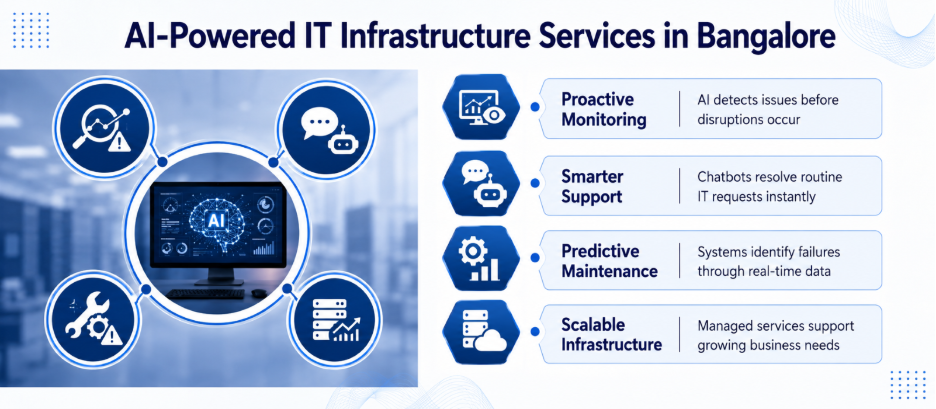
AI is reshaping IT infrastructure services in Bangalore in a fairly specific way. It’s no longer a bolt-on feature bundled into a sales pitch; it’s becoming part of how infrastructure watches over itself. AIOps platforms scan network logs and server performance in real time. Helpdesk chatbots handle routine password resets and access requests instantly, freeing human technicians for problems that actually need judgement.
This matters most for mid-sized companies. A well-configured AI monitoring layer gives a 15-person startup much the same early-warning system a 500-person enterprise would build for itself. It’s one reason more founders now work with a managed IT service provider instead of hiring infrastructure staff from scratch.
Automation: Less About Cutting Jobs, More About Cutting Wait Time
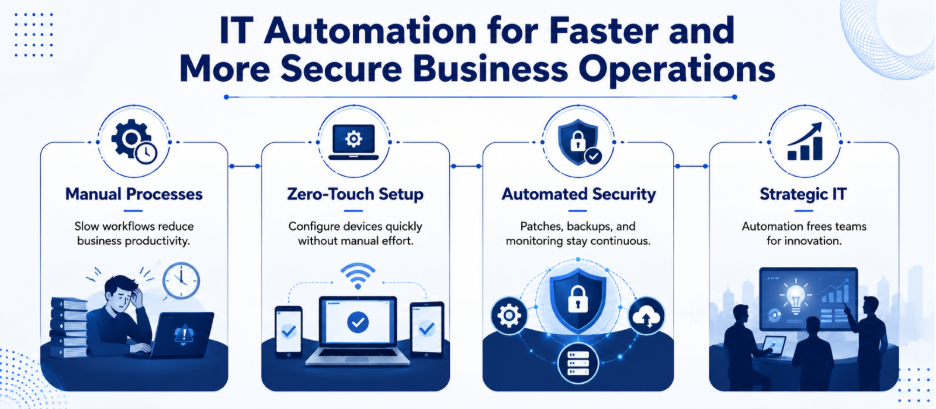
Automation within IT infrastructure services in Bangalore today looks like removing the small, repetitive delays that slow a business down. Zero-touch device provisioning means a new hire’s laptop arrives pre-configured with the right software and security policies, with no manual setup needed. Automated patch management pushes security updates across hundreds of devices overnight. Asset-tracking tools log every laptop, monitor, and server automatically, so nobody’s chasing a spreadsheet to find out who has what.
The result isn’t fewer people in IT; it’s IT teams spending their time on strategy and security instead of routine upkeep. Server setups are a good example of this shift. Proper server installation services in Bangalore now build automated backup, monitoring, and failover into the setup from day one.
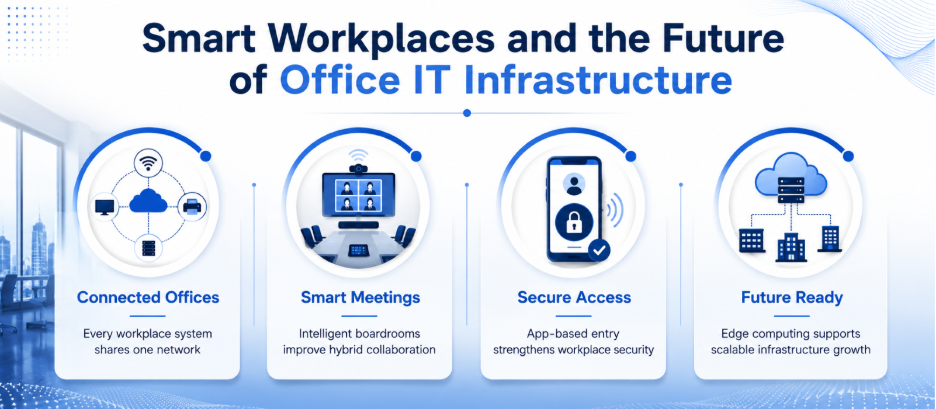
Smart Workplaces: Where IT Infrastructure Services in Bangalore Meet the Office Floor
Perhaps the most visible change is happening in the physical office itself. Meeting rooms with occupancy sensors that adjust lighting and air conditioning on their own. Access control systems that swap ID cards for app-based entry. Boardrooms fitted with intelligent cameras that track speakers and auto-frame video calls. None of this is a gimmick. It cuts energy costs, reduces friction for employees, and makes hybrid collaboration genuinely usable. Therefore, businesses upgrading their meeting spaces are increasingly looking at proper boardroom solutions as part of this shift.
Network security fits into the same picture. As more devices join the same office network, a single weak point can expose everything else connected to it. That’s pushed many Bangalore businesses toward stronger network security solutions built around segmentation and continuous monitoring.
What This Means for Your Business?
None of this requires an enterprise-sized budget to modernise your IT infrastructure services in Bangalore. A few practical steps make the biggest difference:
- Audit before you automate. Map out where your team loses the most time to manual IT tasks, then automate those first.
- Treat security as infrastructure, not an add-on. Firewalls, access control, and monitoring belong in the initial design, not patched on later.
- Plan your office as a network, not just a room. Occupancy sensors, smart displays, and access systems need the same reliable backbone as your servers.
- Pick a partner who scales with you. IT infrastructure services in Bangalore work best when they grow alongside your headcount, instead of forcing a rebuild every eighteen months.
Looking Ahead
The next few years will likely bring wider use of edge computing, broader adoption of hybrid cloud setups, and AI tools that resolve simple problems on their own. Given its density of tech talent and infrastructure providers, Bangalore is well placed to adopt these changes early.
The businesses that benefit most will be the ones that treat IT infrastructure services in Bangalore as a strategic investment. If you want a closer look at how these pieces fit together for your company, get in touch with us!
FAQs
1. What actually falls under “IT infrastructure services” today?
It covers far more than servers and cabling now. A modern scope typically includes networking and Wi-Fi, cloud and hybrid setups, endpoint devices, cybersecurity, asset management, IT helpdesk support, and increasingly, smart office systems like access control and meeting room technology.
2. How is AI-based monitoring different from the traditional IT tools my company already uses?
Traditional tools mostly alert you after something fails. AI-based monitoring looks for patterns, like rising server temperatures or unusual login attempts, and flags them before they turn into an outage or a breach. It’s the difference between a smoke detector and a fire.
3. Will automation reduce the need for an in-house IT person?
Not necessarily. It changes what that person spends time on. Routine tasks like password resets or software updates get automated, while your IT staff (or provider) focuses on security strategy, planning, and the problems that genuinely need a human decision.
4. Do small companies really need “smart workplace” technology, or is it just for large enterprises?
Smaller companies often benefit more, proportionally. A single smart access control system or a well-set-up hybrid meeting room can solve real day-to-day friction without a large capital outlay, and it scales as the team grows.
5. How does India’s data protection law affect my company’s IT infrastructure choices?
The Digital Personal Data Protection Act sets rules around how personal data is collected, stored, and secured. It’s pushed many businesses to reassess where sensitive data lives, whether on local servers, in the cloud, or in a hybrid setup, and to build stronger access controls around it.