How to Evaluate an IT Infrastructure Service Provider Beyond Pricing?
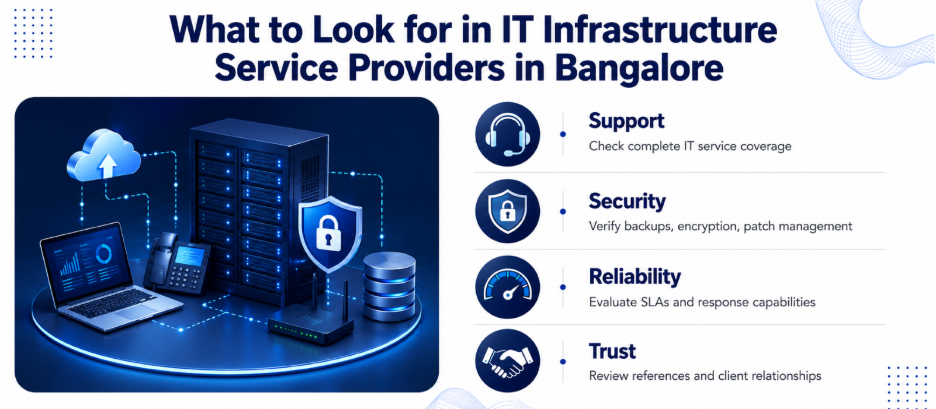
When you’re comparing quotes from IT vendors, it’s tempting to pick whoever comes in cheapest. But the lowest bidder can cost you more through downtime, slow-moving support tickets, or a setup that quietly buckles the moment you hire your next ten people. If you’re currently comparing IT infrastructure service providers in Bangalore, price should be the last filter you apply, not the first. Here’s what actually separates a partner who scales with you from one who just drops off hardware and disappears.
The Real Cost of “Cheap”
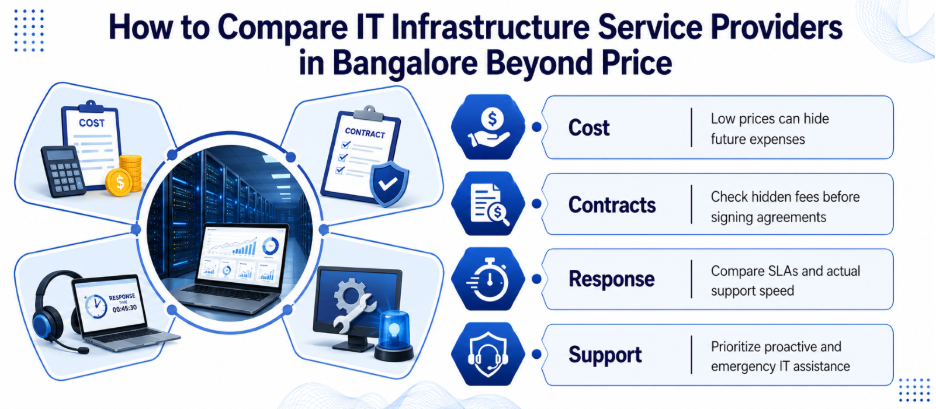
A low quote almost always hides something. Maybe it excludes proactive monitoring, so you only find out about a failing server when it’s already down. Maybe “support” means a callback within 48 hours instead of same-day help. Maybe licensing, warranty renewals, or after-hours visits are billed separately once you’re locked in. None of this shows up on the comparison sheet you’re handed in month one. It shows up as a surprise invoice in month eight.
Response Time Matters More Than the Rate Card
Ask for actual historical numbers, not contract language. A provider can promise a four-hour response window on paper and still leave you waiting if their team is stretched thin across too many clients. Push for specifics: What’s their average first-response time over the last quarter? Do they offer after-hours coverage, or does your 9 PM server crash wait until 9 AM? A provider with a slightly higher rate but a genuinely fast, well-staffed helpdesk will save you more billable hours of downtime than any discount.
One Point of Contact, or Five Different Vendors?
Many businesses end up juggling separate vendors for hardware, networking, and security — and when something breaks, each one blames the others while nothing gets fixed. A provider that manages your laptops, servers, network, and helpdesk under one roof removes that finger-pointing entirely. Before you sign, ask directly whether they’ll be your single point of contact for everything IT-related, or just one piece of a larger puzzle. Our guide on how to choose the right IT infrastructure solution provider walks through exactly what to ask during that conversation.
Security and Compliance Aren’t Optional Extras
Ask how often those backups are actually tested for successful restoration, because an untested backup is close to no backup at all. Ask about device encryption on employee laptops, patch management schedules, and whether they follow recognized frameworks like ISO 27001 for information security. If your business handles customer data, financial records, or health information, regulators and clients alike will eventually ask you to prove it. A solid IT partner should have a documented answer ready.
Can They Actually Grow With You?
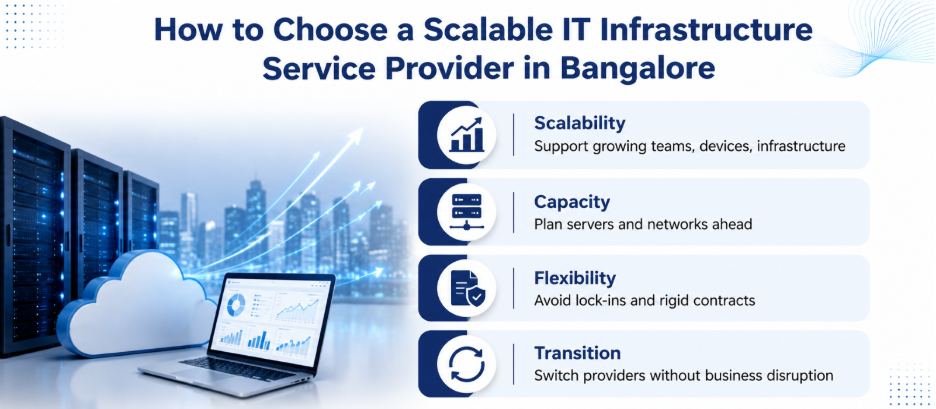
The provider that’s perfect for a 15-person team can fall apart at 80 people. Ask pointed questions: How many clients have you taken from your current headcount to double or triple that size? What breaks first when a company scales fast — and how do you plan around it? If you’re weighing whether to keep IT support in-house or hand it to a partner altogether, in-house versus outsourced IT support models lays out the trade-offs by cost, expertise, and response time.
Talk to Existing Clients — Especially the Ones Who Left
References matter, but ask for two kinds: a client who’s stayed with them for three-plus years, and — if you can get it — someone who switched away. The first tells you about loyalty and consistency. The second tells you where the cracks show up over time. A provider who’s improving keeps growing with businesses while one who’s coasting eventually loses.
Read the Exit Clause Before You Read Anything Else
Lock-in periods, data-handoff terms, and transition support during an offboarding are easy to skip past when you’re excited about a new partnership. Don’t. Although a provider confident in their own value won’t trap you in a contract you can’t leave. But if you ever do need to switch IT vendors without downtime, it all comes down to executing a smooth transition without disrupting daily operations.
Bringing It All Together
If you take one thing away from this, let it be this: the businesses that pick well among IT infrastructure service providers in Bangalore are the ones asking about SLAs, security, and support structure before they ever ask about the invoice.
Price is easy to compare and hard to trust. If you want to know what it’s really like working with a vendor, look past the pitch deck. Their SLAs, security habits, scaling limits, and how they treat existing clients will tell you everything you actually need to know. Therefore, ask harder questions upfront, and the invoice becomes a much smaller part of the decision than it first appeared to be.
Get in touch with Nurture IT to build an IT infrastructure that supports your business today and scales with you tomorrow.
FAQs
1. What’s the biggest mistake businesses make when choosing an IT infrastructure service provider?
Comparing quotes side by side without checking what each one actually includes. Two proposals with similar numbers can cover completely different levels of support, monitoring, and security. The details matter more than the headline figure.
2. How do I know if a provider’s SLA is realistic?
Ask for their actual average response and resolution times from the last few months, not just the number written in the contract. A provider with nothing to hide will usually share this data readily.
3. Is a “one-stop-shop” IT provider always better than using specialists for each function?
Not always, but for most small and mid-sized businesses, a single accountable partner reduces delays and confusion when something breaks across hardware, network, and security at once.
4. How important is industry-specific experience?
It helps. A provider who’s scaled companies from 20 to 100 employees understands timing and priorities that a generalist might miss.
5. What security certifications or practices should I look for?
ISO 27001 alignment, regular patch management, device encryption, and — critically — regularly tested data backups are good starting points to ask about directly.