IT Infrastructure Service Provider SLA: 10 Clauses Businesses Should Review Before Signing
An SLA doesn’t just define how quickly an IT vendor answers a support ticket. It’s the operating contract that translates service expectations into measurable commitments.
That distinction matters. A vague SLA can leave a business with impressive uptime percentages but slow incident resolution, unexpected charges, and limited accountability when something goes wrong.
Therefore, decision- makers should read the SLA as carefully as the commercial proposal before signing with an IT infrastructure service provider. The two documents need to tell the same story.
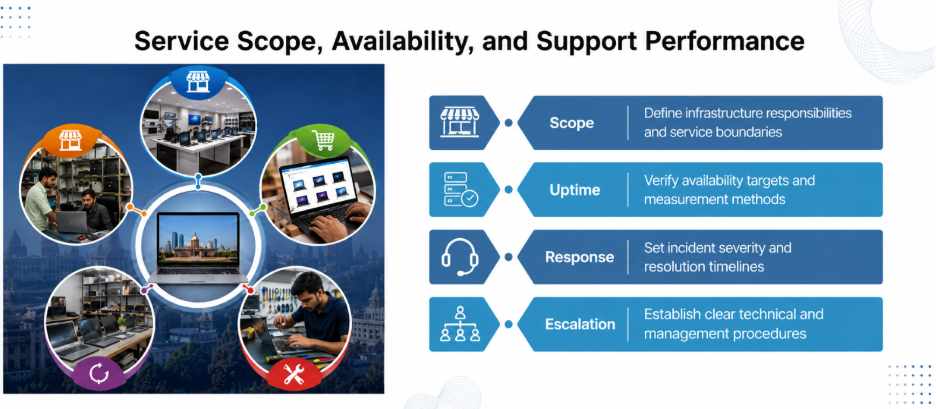
Here are the 10 clauses that deserve the closest scrutiny.
1. Scope of Services
Start with what the provider is actually responsible for.
Does the SLA cover servers, endpoints, networking, firewalls, cloud infrastructure, backups, cybersecurity and user support? Or are some of these services excluded?
The scope should identify supported assets, locations, technologies and service boundaries. It should also state what falls outside the agreement and how additional work is billed.
A useful test is simple: Could two different people read the SLA and reach the same conclusion about what the provider manages? If not, the scope needs work.
2. Availability and Uptime Commitments
“99.9% uptime” sounds impressive until you calculate what it means.
A 99.9% availability commitment permits roughly 8 hours and 46 minutes of downtime in a 365-day year. A higher percentage changes that tolerance significantly.
Therefore, the SLA should define:
- What system or service availability means
- How availability is measured
- The measurement period
- Planned maintenance treatment
- Exclusions such as force majeure
- Whether third-party outages are excluded
Do not accept an uptime figure without understanding the measurement methodology behind it.
3. Incident Severity and Response Times
Not every ticket deserves the same response.
A critical production outage should have a different response commitment from a single-user printer problem. The SLA should therefore establish severity levels and define each one objectively.
For example:
P1: Critical business service unavailable
P2: Major degradation affecting multiple users
P3: Limited operational impact
P4: Routine request or low-impact issue
More importantly, distinguish response time from resolution time. A provider responding within 15 minutes does not mean the problem will be fixed within 15 minutes.
4. Escalation Procedures
When a serious incident remains unresolved, who takes ownership?
Due to this, the SLA should specify technical escalation, management escalation, and communication responsibilities. It should also identify how customers can escalate an incident when normal support channels are insufficient.
This becomes especially important for businesses operating outside standard office hours.
Ask for named escalation roles rather than relying solely on generic support email addresses.
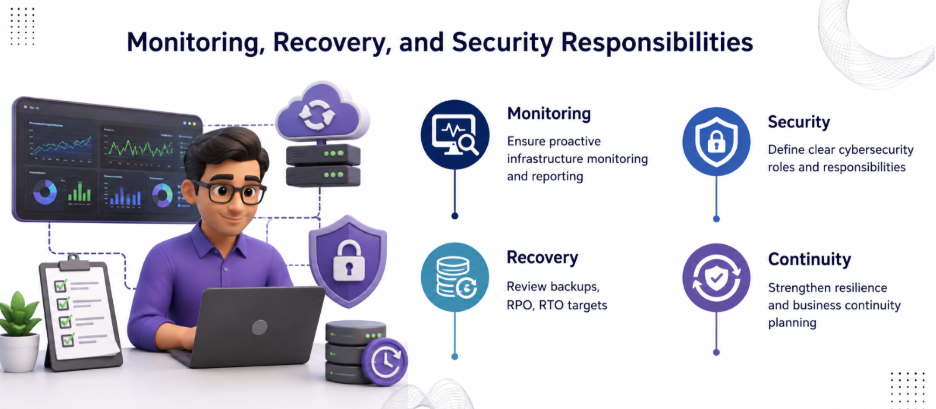
5. Monitoring and Proactive Support
A strong infrastructure SLA should not focus only on what happens after a failure.
Clarify whether the provider performs proactive monitoring of servers, networks, storage, security devices, and critical services. Ask what happens when monitoring detects an abnormal condition before users report it. Also ask what reports you receive.
The important question is not simply whether monitoring exists. It is what the provider monitors, how alerts are handled, and what evidence the customer receives.
6. Backup and Disaster Recovery
“Backups included” is not a sufficient contractual commitment.
The SLA should address backup frequency, retention periods, backup scope, monitoring, restoration procedures, and testing.
Two metrics deserve particular attention:
- RPO (Recovery Point Objective): How much recent data the business can afford to lose.
- RTO (Recovery Time Objective): How quickly a service or system needs to be restored.
These targets should reflect business requirements rather than generic vendor packages.
A backup that cannot be restored when needed has limited practical value. The SLA should therefore state how restoration testing is handled.
7. Security Responsibilities
Security obligations can become blurred when infrastructure is outsourced.
Due to this, the SLA should clarify who handles patching, endpoint protection, firewall administration, privileged access, vulnerability remediation, logging, and security incident escalation.
It should also define customer and provider responsibilities.
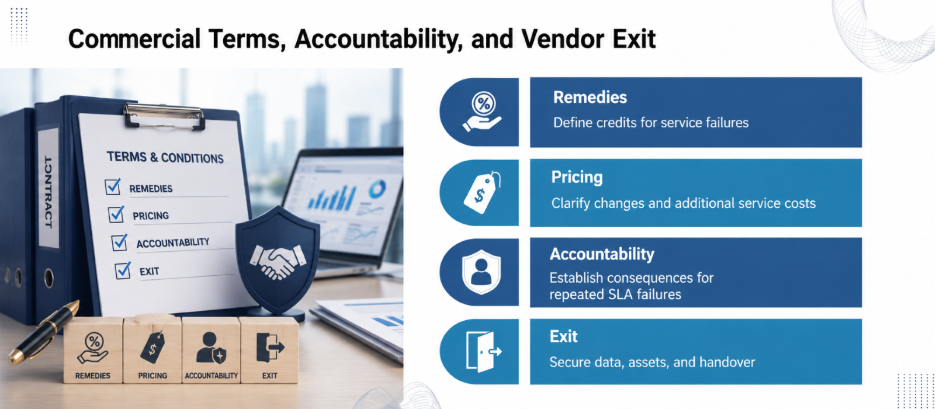
8. Service Credits and Remedies
What happens when the provider misses the SLA?
A meaningful agreement should specify the remedy. This could include service credits or other contractual remedies, depending on the commercial arrangement.
But look beyond the percentage offered. Check:
- What triggers a credit?
- Is the customer required to claim it?
- Is there a monthly cap?
- Are repeated failures treated differently?
- Do credits represent the only remedy?
A service credit may compensate financially, but it does not restore lost productivity. Therefore, persistent SLA failures should have a defined escalation or termination mechanism.
9. Pricing, Change Requests and Out-of-Scope Work
Many disputes begin when the operational team assumes something is included and the vendor treats it as a billable change.
The SLA or associated contract should explain pricing for:
- New devices
- Office additions
- Emergency support
- After-hours work
- Hardware replacement
- Major upgrades
- Projects
- Third-party coordination
Our IT infrastructure service provider cost considerations make an important distinction between upfront costs and ongoing expenses.
Ask for a clear change-control mechanism. Predictable infrastructure management depends as much on commercial clarity as technical capability.
10. Exit, Data and Asset Handover
This is the clause businesses often read last and regret later. The agreement should explain what happens when the relationship ends.
Review provisions covering:
- Data return
- Configuration documentation
- Administrative credentials
- Asset registers
- Backup copies
- Licences
- Vendor-owned equipment
- Knowledge transfer
- Transition assistance
- Deletion of customer data
The customer should know what information and access it receives at exit, how quickly it receives them, and whether transition assistance carries an additional charge.
The SLA Test: Can You Measure It?
The strongest SLA is not necessarily the longest one. It is the one that converts expectations into measurable obligations.
Before signing with an IT infrastructure service provider, take every important promise in the sales discussion and ask: Where is this commitment documented?
A good SLA does more than define service levels. It creates a shared operating model. It tells your internal team what to expect, gives the provider measurable responsibilities, and gives both sides a framework for handling problems before they become disputes.
Need help evaluating or managing your IT infrastructure? Stop by Nurture IT in Indiranagar today!
FAQs
1. What is an IT infrastructure SLA?
A Service Level Agreement defines the services a provider will deliver and the measurable service commitments associated with them, such as availability, response times, resolution targets, and support obligations.
2. What is the most important SLA clause?
There is no single universal clause. Scope, availability, incident response, security, disaster recovery and remedies all matter. The priority depends on which IT services are business-critical.
3. Is 99.9% uptime good?
It can be reasonable for some services, but the percentage alone does not tell the full story. Businesses should examine what is covered, how uptime is calculated, and which exclusions apply.
4. What is the difference between response and resolution time?
Response time measures how quickly the provider acknowledges or begins handling an incident. Resolution time measures how quickly the underlying issue is fixed or the service is restored.
5. Should backup testing be included in an SLA?
If backup and recovery are part of the contracted service, restoration testing should be addressed. The agreement should define frequency, scope, and reporting.