How SaaS Startups Can Optimize IT Costs Without Affecting Performance
SaaS startups operate in a high-growth, high-burn environment where every rupee counts. While technology infrastructure is the backbone of any SaaS product, uncontrolled IT spending can quickly erode margins and limit scalability. The real challenge is to optimize IT costs without compromising application performance, user experience, or security.
In this guide, we discuss practical, proven strategies SaaS startups can implement to reduce IT expenses while maintaining, or even improving, system efficiency.
Why IT Cost Optimization Matters for SaaS Startups
Unlike traditional businesses, SaaS companies rely heavily on cloud infrastructure, development tools, and continuous deployment pipelines. These recurring expenses can spiral if not actively managed.
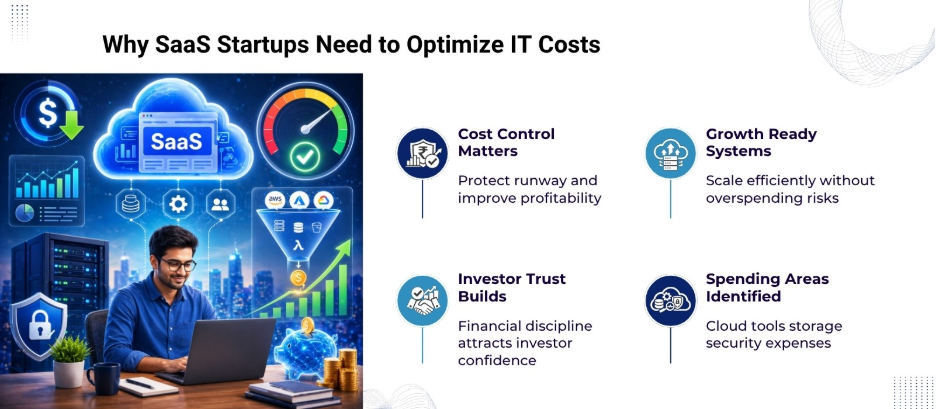
Key reasons to optimize IT costs include:
- Improved runway: Lower burn rate extends operational lifespan
- Better scalability: Efficient systems handle growth without exponential cost increases
- Investor confidence: Financial discipline signals maturity
- Higher margins: Reduced operational expenses directly improve profitability
Cost optimization is not about cutting corners; it’s about spending smarter.
Common IT Cost Drivers in SaaS Startups
Before implementing optimization strategies, it’s important to understand where the money goes:
- Cloud infrastructure (compute, storage, bandwidth)
- SaaS subscriptions (tools, APIs, integrations)
- DevOps and CI/CD pipelines
- Data storage and backup systems
- Monitoring and logging tools
- Security and compliance solutions
Identifying these cost centers helps prioritize optimization efforts.
10 Proven Strategies to Optimize IT Costs
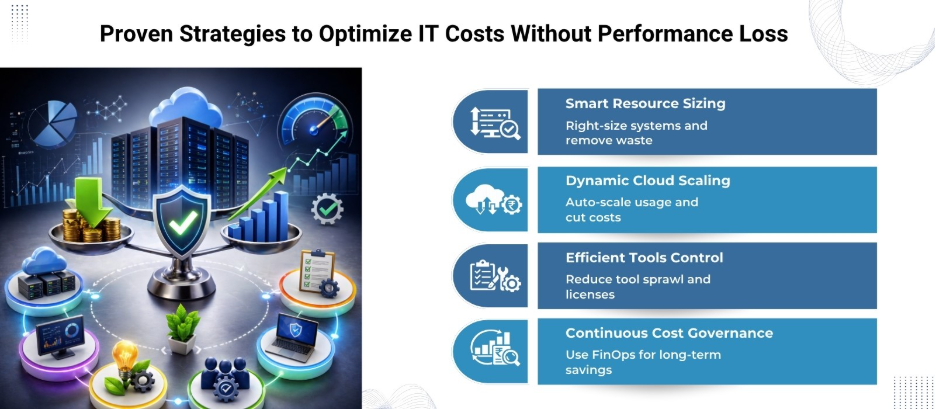
1. Right-Size Your Cloud Infrastructure
One of the biggest sources of waste in SaaS startups is overprovisioned resources.
What to do:
- Analyze usage metrics regularly
- Downgrade underutilized instances
- Match instance types to workload requirements
Impact: Reduces unnecessary compute expenses without affecting performance.
2. Adopt Auto-Scaling and Elastic Infrastructure
Instead of running systems at peak capacity all the time, use auto-scaling to adjust resources dynamically.
Benefits:
- Pay only for what you use.
- Handle traffic spikes efficiently
- Avoid downtime during high demand
This approach is fundamental for startups aiming to optimize IT costs while maintaining reliability.
3. Use Reserved or Spot Instances
Cloud providers offer discounted pricing models:
- Reserved instances: Lower cost for long-term commitments
- Spot instances: Significant discounts for flexible workloads
Best use cases:
- Background jobs
- Batch processing
- Non-critical workloads
4. Optimize Storage Strategy
Data storage can become expensive as your product scales.
Optimization tips:
- Use tiered storage (hot, warm, cold)
- Delete unused or duplicate data
- Compress large datasets
- Archive infrequently accessed files
5. Reduce SaaS Tool Sprawl
Startups often accumulate too many tools across teams.
Steps to control this:
- Audit all subscriptions
- Consolidate overlapping tools
- Eliminate unused licenses
This not only helps optimize IT costs but also improves operational efficiency.
6. Implement Efficient CI/CD Pipelines
Continuous integration and deployment pipelines can consume significant compute resources.
Optimization techniques:
- Run builds only when necessary
- Use caching to speed up processes
- Optimize test suites
- Schedule non-critical builds during off-peak hours
7. Monitor and Eliminate Idle Resources
Idle resources are silent budget killers.
Examples:
- Unused virtual machines
- Orphaned storage volumes
- Inactive load balancers
Solution:
- Use monitoring tools to identify unused assets
- Automate shutdown of idle resources
8. Optimize Application Architecture
Efficient code and architecture directly impact infrastructure costs.
Best practices:
- Use microservices where appropriate
- Optimize database queries
- Implement caching (e.g., Redis)
- Minimize API calls
Well-optimized applications require fewer resources to run.
9. Leverage Open-Source Solutions
Instead of relying on expensive proprietary tools, consider open-source alternatives.
Advantages:
- Lower licensing costs
- High flexibility
- Strong community support
However, factor in maintenance and support requirements before switching.
10. Implement FinOps Practices
FinOps (Financial Operations) is a cultural and operational practice that brings financial accountability to cloud spending.
Core principles:
- Real-time cost visibility
- Cross-team collaboration
- Continuous optimization
Startups that adopt FinOps early can maintain cost efficiency as they scale.
IT Cost Optimization Strategy Table
| Strategy | Key Action | Cost Impact | Performance Impact |
| Right-sizing resources | Match usage to capacity | High savings | No negative impact |
| Auto-scaling | Scale resources dynamically | Medium to high | Improves reliability |
| Reserved/spot instances | Use discounted pricing models | High savings | Minimal risk |
| Storage optimization | Tiering and cleanup | Medium savings | No impact |
| SaaS tool consolidation | Reduce redundant tools | Medium savings | Improves efficiency |
| CI/CD optimization | Efficient builds and pipelines | Medium savings | Faster deployments |
| Idle resource management | Remove unused assets | High savings | No impact |
| Architecture optimization | Efficient system design | High savings | Improves performance |
| Open-source adoption | Replace paid tools | Medium savings | Depends on setup |
| FinOps implementation | Continuous cost monitoring | Long-term savings | Sustains performance |
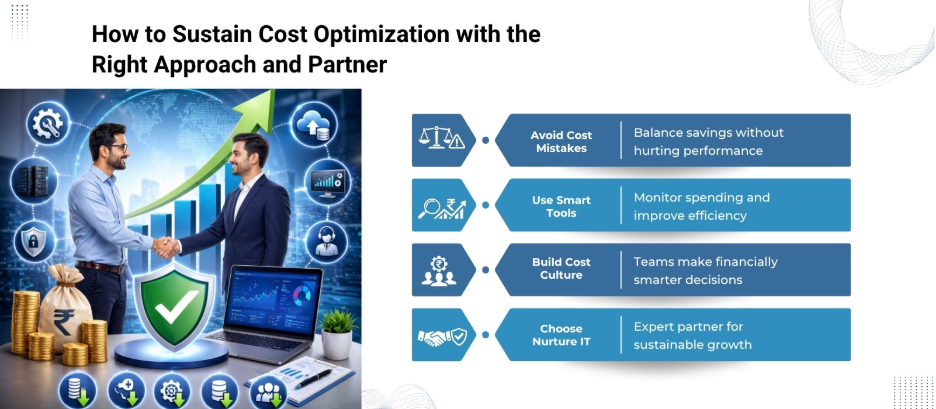
Balancing Cost and Performance: What Startups Must Avoid
While trying to optimize IT costs, startups often make mistakes that hurt performance:
Cutting Critical Resources
Reducing compute power or bandwidth too aggressively can lead to:
- Slow application response times
- Downtime during peak traffic
- Poor user experience
Ignoring Monitoring
Without proper monitoring:
- Issues go undetected
- Performance degrades over time
Over-Optimization
Excessive cost-cutting can result in:
- Complex systems
- Reduced developer productivity
The goal is balance, not just savings.
Tools That Help Optimize IT Costs
Several tools can support cost optimization efforts:
- Cloud cost monitoring platforms
- Application performance monitoring (APM) tools
- Infrastructure automation tools
- Usage analytics dashboards
These tools provide visibility and control, which are essential for effective cost management.
Building a Cost-Conscious Engineering Culture
Technology decisions are often made by engineering teams, so cost awareness must be part of the culture.
How to build it:
- Share cost metrics with teams
- Set budgets for projects
- Encourage accountability
- Reward efficiency improvements
When teams understand the financial impact of their decisions, they naturally work to optimize IT costs.
Why Choose Nurture IT?
Nurture IT in Indiranagar empowers SaaS startups to scale efficiently by aligning technology decisions with business outcomes. In an environment where every infrastructure choice impacts both performance and cost, Nurture IT brings clarity, control, and measurable results. The approach goes beyond basic cost-cutting to focusing on building a high-performance, cost-efficient IT ecosystem that supports long-term growth.
What Nurture IT Offers
Nurture IT delivers end-to-end solutions designed to help startups optimize IT costs without affecting performance. Services include cloud cost optimization, infrastructure right-sizing, DevOps pipeline efficiency, and real-time monitoring. By identifying underutilized resources, eliminating redundancies, and improving system architecture, Nurture IT helps reduce waste while enhancing speed and reliability.
Final Thoughts
For SaaS startups, managing IT expenses is not just about cutting costs; it’s about building a sustainable, scalable business. By adopting smart strategies, companies can optimize IT costs without sacrificing performance.
If you’re looking to reduce cloud spend while maintaining peak performance, Nurture IT can help you get there faster. With expertise in SaaS infrastructure, cost optimization, and performance engineering, Nurture IT helps you identify inefficiencies, streamline operations, and scale sustainably. Connect with our team in Indiranagar, Bangalore, today!
FAQs
1. What does it mean to optimize IT costs in SaaS?
It involves reducing unnecessary technology expenses while maintaining system performance, reliability, and scalability.
2. Can cost optimization affect application performance?
If done incorrectly, yes. However, strategic optimization often improves performance by eliminating inefficiencies.
3. What is the biggest cost driver for SaaS startups?
Cloud infrastructure, particularly compute and storage, is typically the largest expense.
4. How often should IT costs be reviewed?
Ideally, startups should review costs monthly or in real time using monitoring tools.
5. Is open-source always cheaper than paid tools?
Not always. While licensing costs are lower, maintenance and support requirements can add overhead.
6. What is FinOps and why is it important?
FinOps is a practice that combines finance and operations to manage cloud spending effectively and continuously.