Top 7 IT Mistakes Startups Make While Scaling (And How to Avoid Them)
Scaling a startup is an exciting phase, but it also exposes cracks in your technology foundation. What worked for a team of 5 often collapses under the pressure of 50 or 500 users. Poor IT decisions at this stage can lead to downtime, security risks, wasted budgets, and lost opportunities.
This is where managed IT service providers play a key role. They bring structure, expertise, and scalability to your IT operations, so you can avoid pitfalls while supporting growth.
In this blog, we’ll explore the top 7 IT mistakes startups make while scaling and practical ways to avoid them.
Why IT Strategy Matters During Scaling
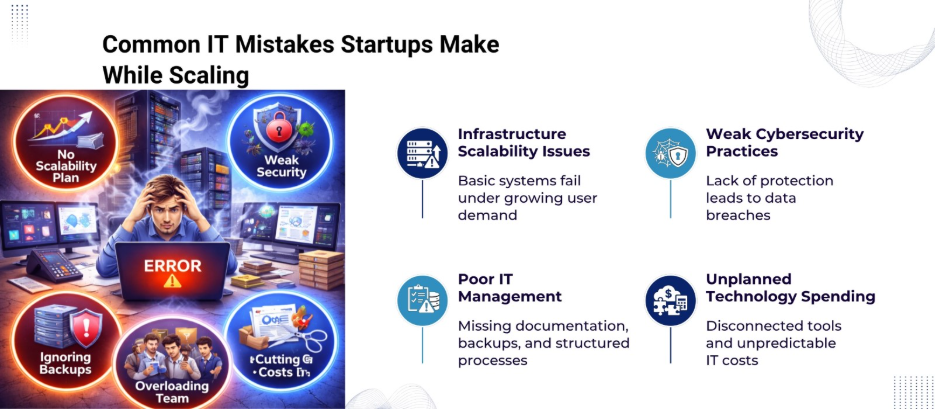
As your startup grows, your IT environment becomes more complex. You’re handling more data, onboarding more users, integrating more tools, and facing higher cybersecurity risks.
Without a proper IT strategy:
- Systems become slow and unreliable
- Security vulnerabilities increase
- Costs spiral out of control
- Teams lose productivity
However, partnering with managed IT service providers helps startups build a scalable, secure, and cost-efficient IT ecosystem from the ground up.
Top IT Mistakes Startups Make While Scaling
1. Ignoring Scalable Infrastructure
The Mistake:
Many startups rely on basic infrastructure in the early stages, like shared hosting, local servers, or ad-hoc cloud setups. As demand grows, these systems fail to handle increased traffic and workloads.
Impact:
- Frequent downtime
- Slow application performance
- Poor user experience
How to Avoid It:
Invest in scalable cloud infrastructure (like AWS, Azure, or Google Cloud) that can grow with your business. Managed IT service providers can design flexible architectures with auto-scaling capabilities and load balancing.
2. Weak Cybersecurity Measures
The Mistake:
Startups often delay investing in cybersecurity, assuming they’re too small to be targeted.
Reality Check:
Small businesses are frequent targets because they typically lack strong defenses.
Impact:
- Data breaches
- Financial loss
- Legal penalties
- Damaged reputation
How to Avoid It:
Implement:
- Multi-factor authentication (MFA)
- Endpoint protection
- Regular security audits
- Employee training
Managed IT service providers can proactively monitor threats and implement enterprise-grade security solutions.
3. Lack of IT Documentation
The Mistake:
Important processes, configurations, and system details are not documented.
Impact:
- Knowledge loss when employees leave
- Slower troubleshooting
- Dependency on specific individuals
How to Avoid It:
Maintain clear documentation for:
- Network architecture
- Software configurations
- Access credentials (securely stored)
- Incident response procedures
Professional managed IT service providers maintain structured documentation as part of their service.
4. Overlooking Backup and Disaster Recovery
The Mistake:
Startups often skip regular backups or rely on manual processes.
Impact:
- Permanent data loss
- Business interruption
- Costly recovery efforts
How to Avoid It:
Set up:
- Automated backups
- Offsite/cloud storage
- Disaster recovery plans
A reliable managed IT service provider will implement backup strategies with defined Recovery Time Objectives (RTO) and Recovery Point Objectives (RPO).
5. Using Too Many Disconnected Tools
The Mistake:
Startups adopt multiple tools for communication, project management, CRM, and analytics without proper integration.
Impact:
- Data silos
- Reduced productivity
- Inefficient workflows
How to Avoid It:
Choose integrated platforms or use APIs to connect systems. Streamlining tools improve efficiency and data visibility.
Managed IT service providers help in selecting and integrating tools that align with your business goals.
6. Not Planning for IT Costs
The Mistake:
IT expenses are treated as unpredictable or secondary.
Impact:
- Budget overruns
- Unexpected expenses
- Delayed growth initiatives
How to Avoid It:
Create a structured IT budget that includes:
- Infrastructure costs
- Software subscriptions
- Security investments
- Maintenance and upgrades
With managed IT service providers, startups can shift to predictable monthly pricing models.
7. Delaying Professional IT Support
The Mistake:
Founders or non-IT staff handle IT tasks to save money.
Impact:
- Inefficient systems
- Increased downtime
- Security risks
- Slower scaling
How to Avoid It:
Outsource IT management early to experts. Managed IT service providers offer:
- 24/7 monitoring
- Technical expertise
- Faster issue resolution
- Strategic IT planning
Quick Summary Table
| Mistake | Impact | Solution |
| Ignoring scalable infrastructure | Downtime, slow performance | Use cloud-based scalable systems |
| Weak cybersecurity | Data breaches, financial loss | Implement security protocols & monitoring |
| Lack of documentation | Knowledge gaps, inefficiency | Maintain detailed IT documentation |
| No backup strategy | Data loss, business disruption | Automate backups & disaster recovery |
| Too many disconnected tools | Data silos, inefficiency | Integrate tools and platforms |
| Poor IT cost planning | Budget overruns | Create structured IT budgets |
| Delayed IT support | System inefficiencies | Partner with managed IT service providers |
Benefits of Partnering with Managed IT Service Providers
Working with managed IT service providers offers startups several advantages:
1. Cost Efficiency
Instead of hiring a full in-house IT team, startups get access to a team of experts at a fraction of the cost.
2. Proactive Monitoring
Issues are identified and resolved before they affect operations.
3. Scalability
IT systems are designed to grow with your business.
4. Enhanced Security
Advanced tools and continuous monitoring reduce cybersecurity risks.
5. Focus on Core Business
Your team can concentrate on innovation and growth rather than IT issues.
Signs Your Startup Needs Managed IT Services
If you’re experiencing any of the following, it’s time to consider managed IT service providers:
- Frequent system downtime
- Slow application performance
- Increasing cybersecurity concerns
- Lack of internal IT expertise
- Rapid team expansion
- Difficulty managing multiple tools
Best Practices for Scaling IT Successfully
To avoid these common mistakes, follow these proven strategies:
Build a Long-Term IT Roadmap
Align your IT strategy with your business goals and growth plans.
Prioritize Security from Day One
Security should be integrated into every system and process, not added later.
Automate Wherever Possible
Automation reduces manual errors and improves efficiency.
Regularly Audit Your Systems
Periodic reviews help identify inefficiencies and vulnerabilities.
Choose the Right IT Partner
Not all providers are the same. Look for experience, scalability, and proactive support.
Why Choose Nurture IT
Nurture IT helps ambitious businesses scale smarter with reliable, secure, and future-ready technology solutions. As a trusted name among managed IT service providers in Indiranagar, we deliver proactive monitoring, robust cybersecurity, and seamless cloud infrastructure tailored to your growth journey. Our expert team works behind the scenes to minimize downtime, optimize performance, and simplify IT management, so you can focus on growing your business.
Final Thoughts
Scaling a startup is not just about acquiring customers; it’s about building a strong foundation that supports growth. IT plays a key role in this journey, and small mistakes can turn into major setbacks if left unaddressed.
By avoiding these seven common IT mistakes and partnering with experienced managed IT service providers, startups can build resilient, secure, and scalable systems that drive long-term success.
Ready to optimize your IT strategy? Partner with Nurture IT today and take the next step toward smarter, stress-free scaling.
FAQs
1. What are the most common IT mistakes startups make while scaling?
Startups often struggle with poor infrastructure planning, weak cybersecurity, lack of backups, and relying on unstructured IT processes. These issues can slow down growth and increase risks.
2. Why is a scalable IT infrastructure important for startups?
Scalable infrastructure helps startups handle increasing users, data, and workloads without performance issues or downtime.
3. How do managed IT service providers help startups scale?
Managed IT service providers offer expert support, proactive monitoring, and scalable solutions that help startups manage IT efficiently while focusing on growth.
4. What cybersecurity measures should startups prioritize?
Startups should implement multi-factor authentication, endpoint security, regular updates, firewalls, and employee awareness training.
5. How often should startups back up their data?
Critical business data should be backed up daily or in real time, depending on business needs and risk tolerance.