How IT Warehousing Services Are Solving Hardware Management Challenges for Growing Companies
Growth is exciting until hardware management starts slowing everything down.
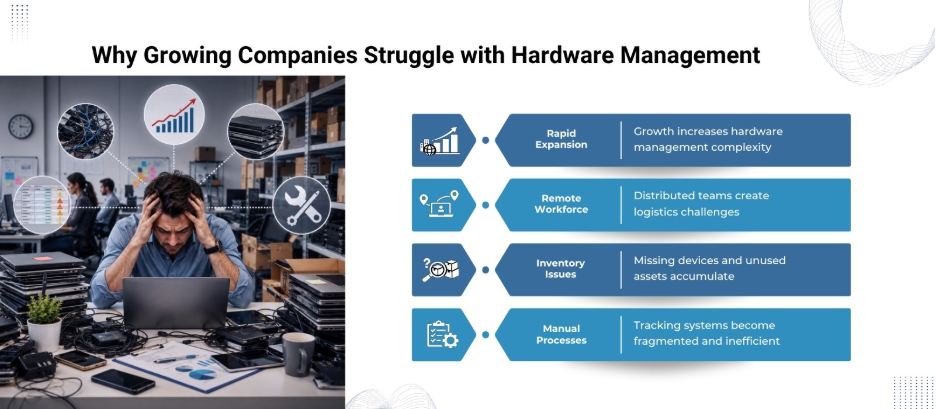
A company hires faster, opens new branches, supports remote employees, upgrades devices, and expands cloud infrastructure. Suddenly, laptops go missing, unused devices pile up, deployment delays increase, and IT teams spend more time tracking hardware than supporting business goals.
This is exactly why IT warehousing services have become a critical operational strategy for growing companies.
Instead of treating hardware storage and device deployment as a side task, businesses are now adopting centralized IT warehousing models that handle inventory management, staging, configuration, logistics, repairs, replacements, asset recovery, and secure disposal from one organized system. Industry providers now support everything from real-time asset tracking and secure storage to reverse logistics and lifecycle management.
Why Hardware Management Becomes Difficult During Business Growth
In the early stages, hardware management is relatively simple. A small IT team can manually track laptops, monitors, servers, and accessories without major problems.
But growth changes everything. A scaling company may have:
- Hybrid or remote employees across multiple cities
- Frequent onboarding and offboarding
- Multiple hardware vendors
- Device refresh cycles
- Compliance requirements
- Temporary project teams
- Expansion into new offices
As the hardware footprint grows, manual tracking becomes unreliable.
Therefore, IT teams often struggle with:
- Missing or untracked devices
- Delayed employee onboarding
- Excess inventory sitting unused
- Difficulty forecasting hardware demand
- Complicated returns and repairs
- Security risks during disposal
- Lack of visibility into asset lifecycle costs
According to enterprise IT lifecycle providers, hardware complexity increases significantly when organizations manage procurement, storage, deployment, maintenance, and retirement separately.
This fragmentation creates operational bottlenecks that directly affect productivity.
What Are IT Warehousing Services?
IT warehousing services are centralized solutions designed to manage the storage, movement, deployment, tracking, maintenance, and retirement of IT assets.
These services typically include:
- Secure hardware storage
- Inventory management
- Device staging and imaging
- Asset tagging
- Configuration and kitting
- Shipping and logistics
- Reverse logistics
- Hardware refresh support
- Repair coordination
- Secure asset disposal
Instead of maintaining large in-house storage operations, companies partner with specialized providers that manage the entire hardware lifecycle.
Many providers now integrate automation, AI-based inventory tracking, and real-time visibility dashboards to simplify large-scale asset operations.
This allows growing businesses to scale without overwhelming their internal IT departments.
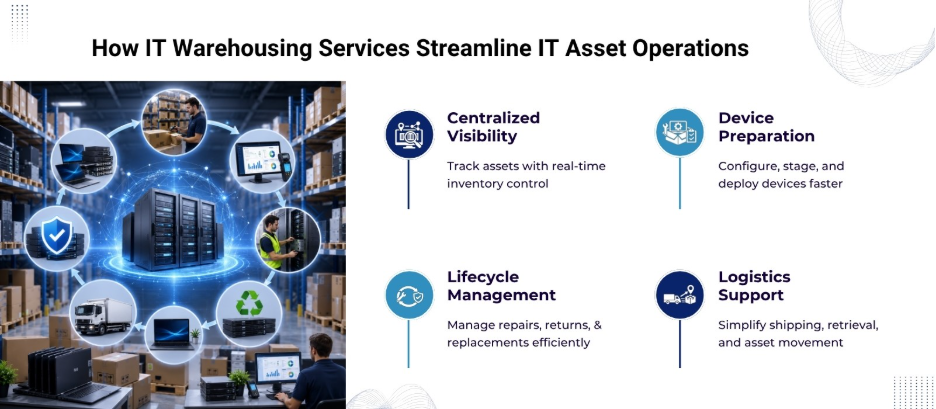
Centralized Inventory Visibility Reduces Chaos
One of the biggest problems growing companies face is poor hardware visibility.
IT managers often cannot answer simple questions like:
- Which employee has which device?
- How many backup laptops are available?
- Which devices are nearing end-of-life?
- What hardware is sitting unused in storage?
Without centralized visibility, companies overspend on unnecessary purchases while perfectly usable devices remain forgotten in storage rooms.
IT warehousing services solve this by creating a centralized inventory ecosystem. Modern platforms track:
- Serial numbers
- Device locations
- Warranty status
- User assignments
- Repair history
- Lifecycle stage
- Shipping activity
Providers highlight real-time asset visibility and digitized tracking as core operational benefits. This level of visibility helps companies make smarter procurement decisions and reduce waste.
Faster Employee Onboarding and Device Deployment
Rapid hiring creates deployment pressure.
When new employees join, they expect fully configured devices immediately. However, delays affect productivity and create poor onboarding experiences.
Without warehousing support, internal IT teams may spend hours manually preparing devices.
IT warehousing services streamline this process through pre-deployment staging.
Devices can arrive fully configured with:
- Operating systems installed
- Security settings applied
- Company software preloaded
- Asset tags attached
- User credentials assigned
- Department-specific accessories included
Some providers also offer zero-touch deployment, where devices are shipped directly to employees ready for immediate use.
For growing companies managing remote workforces, this dramatically reduces setup time.
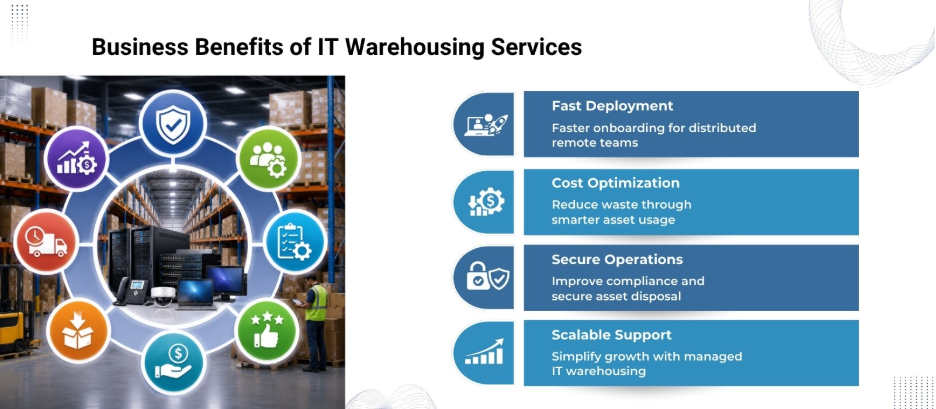
Better Support for Hybrid and Remote Work
Remote and hybrid work models changed hardware logistics permanently.
Companies no longer manage devices from one office location. Employees may work from different cities, countries, or time zones.
This creates new operational problems:
- Shipping delays
- Device retrieval challenges
- Complicated repair coordination
- Replacement management issues
- Inventory imbalance across locations
IT warehousing services act as centralized distribution hubs that support geographically distributed teams. This allows businesses to support remote employees without building expensive internal logistics infrastructure.
Lower Operational Costs Through Smarter Asset Utilization
Many growing companies spend more on hardware than necessary because they lack accurate lifecycle visibility. Therefore, duplicate purchases happen frequently when unused inventory cannot be tracked properly.
IT warehousing services reduce these inefficiencies by helping businesses:
- Reuse recoverable devices
- Refurbish older hardware
- Track idle inventory
- Forecast refresh cycles
- Reduce emergency purchases
- Avoid overstocking
Lifecycle-focused asset management also improves budget planning.
Several enterprise lifecycle providers emphasize predictable spending and proactive refresh management as key business advantages.
Instead of reacting to hardware shortages, companies can plan upgrades strategically.
Improved Security and Compliance
Hardware management is also a security issue. Improperly stored or disposed devices can expose sensitive company data.
As businesses grow, compliance requirements become stricter, especially in industries like healthcare, finance, and enterprise technology.
IT warehousing services support security through:
- Secure storage facilities
- Controlled chain-of-custody
- Serialized asset tracking
- Certified data wiping
- Secure disposal processes
- Compliance documentation
Scalability Without Expanding Internal IT Teams
One of the biggest advantages of IT warehousing services is operational scalability. A company may double its workforce in a year, but expanding internal logistics operations at the same pace is expensive and difficult.
Building in-house warehousing capabilities requires:
- Physical storage space
- Security systems
- Inventory software
- Logistics staff
- Shipping coordination
- Repair partnerships
- Asset tracking systems
IT warehousing providers already have this infrastructure in place.
As a result, businesses can scale hardware operations without significantly increasing internal headcount. This allows internal IT teams to focus on higher-value initiatives like cybersecurity, cloud infrastructure, automation, and digital transformation.
Sustainability Is Becoming Part of Hardware Strategy
Sustainability is no longer optional in enterprise IT.
Improper disposal of outdated hardware contributes to electronic waste and environmental risks.
Modern IT warehousing services support sustainable hardware practices through:
- Device refurbishment
- Certified recycling
- Component recovery
- Asset redeployment
- Lifecycle optimization
Lifecycle management providers increasingly promote reuse and environmentally responsible IT disposal as part of long-term operational planning.
Simplify Hardware Management with Nurture IT Warehousing Services
Growing companies often struggle with laptop tracking, employee onboarding logistics, reverse asset collection, and managing distributed IT inventory. That’s where Nurture IT steps in with specialized IT warehousing solutions designed for startups and SMBs. Our services cover secure device storage, asset management, forward and reverse logistics, laptop deployment, device refurbishment, and nationwide shipping support for remote teams.
Our hands-on approach to lifecycle management – from preparing devices for new employees to retrieving, cleaning, reformatting, and reallocating returned assets – simplifies hardware operations for fast-growing businesses.
For startups scaling across multiple locations, Nurture IT acts as an extended IT operations partner rather than just a logistics provider. Get in touch with us or visit our Indiranagar office today!
FAQs
1. What are IT warehousing services?
IT warehousing services are solutions that help businesses manage the storage, tracking, deployment, maintenance, and disposal of IT hardware such as laptops, desktops, servers, and accessories.
2. Why are IT warehousing services important for growing companies?
As companies expand, managing hardware across multiple teams and locations becomes difficult. IT warehousing services simplify inventory control, logistics, and device lifecycle management.
3. How do IT warehousing services support remote employees?
These services help businesses ship pre-configured devices directly to remote employees, manage replacements, and coordinate hardware returns from different locations.
4. Can IT warehousing services reduce IT operational costs?
Yes. They help reduce unnecessary hardware purchases, improve asset utilization, minimize inventory waste, and support device refurbishment and reuse.
5. What types of hardware are managed through IT warehousing services?
Most providers manage laptops, desktops, monitors, servers, networking equipment, accessories, and mobile devices.