How Endpoint Security Protects Hybrid Workforces
The modern workplace has changed in the last few years. Employees no longer work only from corporate offices. Today, teams switch between home offices, coworking spaces, client locations, airports, and company headquarters. While this flexibility has improved productivity and employee satisfaction, it has also introduced new security challenges.
Every laptop, smartphone, tablet, and desktop connected to company resources becomes a potential entry point for cybercriminals. As organizations embrace hybrid work models, endpoint security has become one of the most important pillars of modern business cybersecurity.
Why Hybrid Work Creates New Security Risks
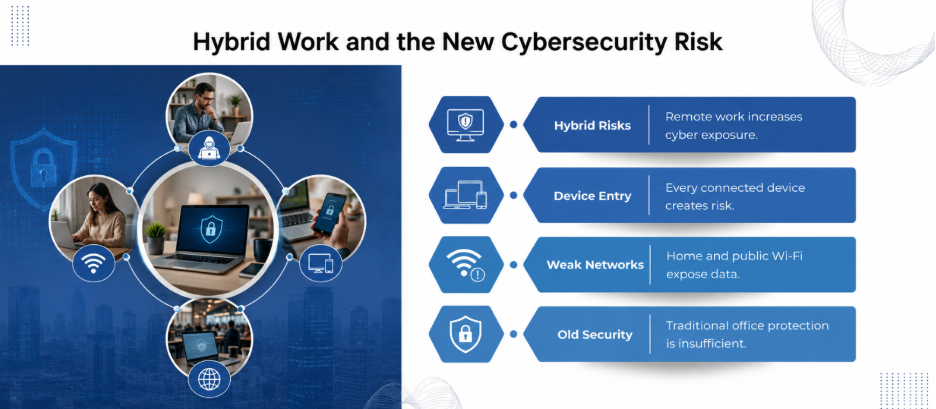
Traditional office environments operated within controlled networks. Security teams could monitor traffic, manage devices, and apply protections from a centralized location. However, hybrid work changes this dynamic.
Employees now connect through:
- Home Wi-Fi networks
- Public internet connections
- Personal devices
- Cloud applications
- Third-party collaboration tools
This is why the traditional network perimeter has largely disappeared.
Cybercriminals understand this shift. Instead of targeting heavily protected corporate data centers, attackers increasingly focus on employee devices because they are often easier to compromise.
A phishing email opened on a laptop at home can create the same level of risk as a breach occurring inside a corporate office. In many cases, attackers view endpoints as the fastest path into an organization.
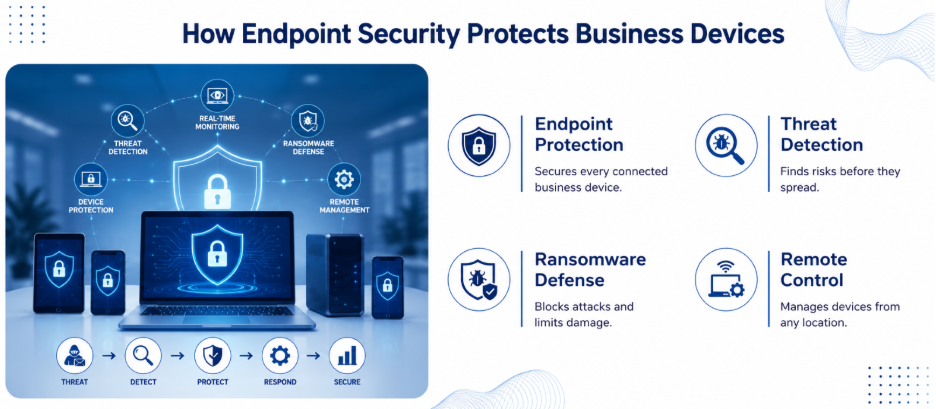
What Is Endpoint Security?
Endpoint security refers to technologies, policies, and processes designed to protect devices that connect to business systems and networks.
These endpoints include:
- Laptops
- Desktop computers
- Smartphones
- Tablets
- Servers
- Point-of-sale devices
- Internet-connected business equipment
Today, endpoint security goes far beyond traditional antivirus software.
Modern solutions provide:
- Threat detection and response
- Device monitoring
- Malware prevention
- Behavioral analysis
- Application control
- Data protection
- Remote device management
The objective is to stop threats before they can compromise business operations.
Also Read: Cybersecurity Awareness Matters More Than Technology
The Expanding Attack Surface of Hybrid Workforces
Every new device added to a business environment opens another door for trouble.
Consider a company with 500 employees working in a hybrid model. Each employee may use:
- A company laptop
- A smartphone
- Cloud-based applications
- Collaboration platforms
Managing this architecture means securing thousands of individual connections because attackers exploit vulnerabilities like:
| Common Threat | Potential Impact |
| Phishing attacks | Credential theft |
| Ransomware | Business disruption |
| Malware infections | Data compromise |
| Unpatched software | Unauthorized access |
| Stolen devices | Data exposure |
| Insider threats | Information leakage |
Endpoint security helps organizations monitor and protect every one of these potential risk points.
Detecting Threats Before They Spread
One of the biggest advantages of modern endpoint security is its ability to identify suspicious activity early.
Traditional security tools often relied on known malware signatures. While useful, this approach struggles against new and evolving threats.
Modern endpoint detection systems use behavioral analysis to identify unusual actions.
Examples include:
- Unexpected file encryption
- Unauthorized privilege escalation
- Suspicious application activity
- Unusual login behavior
- Data transfers outside normal patterns
By identifying abnormal behavior quickly, organizations can contain threats before they spread across the network.
For hybrid workforces, where employees may be working from different locations and devices, this visibility is necessary.
Protecting Against Ransomware Attacks
Ransomware continues to dominate the cyber threat landscape.
Attackers typically gain access through:
- Phishing emails
- Malicious downloads
- Exploited software vulnerabilities
- Compromised credentials
Once inside a device, ransomware can encrypt files and instantly disrupt business operations. For hybrid employees, the risk increases because users often operate outside traditional office protections.
However, endpoint security reduces ransomware risks by:
- Blocking malicious files
- Monitoring suspicious behaviors
- Isolating infected devices
- Detecting unauthorized encryption activity
- Preventing lateral movement across systems
This layered protection reduces the likelihood of a successful attack.
Securing Remote Devices Anywhere
One major challenge for IT teams is managing devices that rarely enter the office. Employees may work remotely for weeks or months while accessing critical business systems.
Therefore, endpoint security solutions help administrators:
- Deploy security updates remotely
- Monitor device health
- Enforce security policies
- Lock compromised devices
- Remove sensitive data from lost or stolen equipment
This capability helps maintain strong business cybersecurity regardless of employee location.
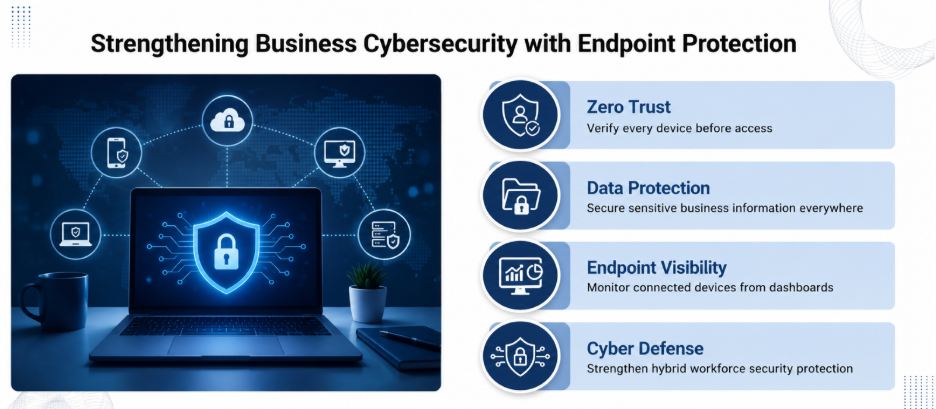
Supporting Zero Trust Security Strategies
Many organizations are adopting Zero Trust security frameworks to address modern threats.
The core principle of Zero Trust is straightforward:
Never trust automatically. Always verify.
Under this approach:
- Users must authenticate continuously.
- Devices must meet security requirements.
- Access is granted based on risk levels.
- Permissions are limited to necessary resources.
Endpoint security plays an important role in supporting Zero Trust environments.
Before granting access, organizations can verify:
- Device health status
- Security patch levels
- Presence of malware
- Compliance with company policies
This helps prevent compromised devices from becoming gateways into business systems.
Also Read: Inside Cisco Network Security Solutions: How Enterprises Are Building Zero-Trust Networks
Protecting Sensitive Business Data
Hybrid work increases the movement of data across devices, applications, and networks.
Employees regularly access:
- Customer records
- Financial information
- Intellectual property
- Internal communications
- Strategic business documents
Without proper controls, sensitive information can be exposed through accidental sharing, malware infections, or unauthorized access.
Endpoint security helps safeguard data through:
- Device encryption
- Access controls
- Data loss prevention tools
- File monitoring
- Secure storage policies
These protections reduce the likelihood of data breaches and regulatory violations.
Improving Visibility Across the Organization
One of the most difficult challenges in hybrid environments is maintaining visibility.
Security teams need answers to questions such as:
- Which devices are connected?
- Are devices fully updated?
- Has suspicious activity been detected?
- Are security policies being followed?
- Which endpoints present the highest risk?
Therefore, endpoint security platforms provide centralized dashboards that help organizations monitor their entire device ecosystem.
This visibility helps security teams identify risks quickly and make decisions before problems escalate.
Strengthen Your Business Cybersecurity with Nurture IT
At Nurture IT, we help organizations build stronger business cybersecurity frameworks through advanced endpoint protection, device management, network security, and threat monitoring solutions.
Our team works closely with businesses to identify security gaps, implement proactive defense measures, and maintain visibility across every connected endpoint. Whether your employees work from the office, remotely, or in a hybrid environment, we provide the tools and expertise needed to reduce cyber risks. Through our partnerships with leading technology providers like Cisco, Sophos, etc., we deliver customized security solutions.
Final Thoughts
Hybrid work is no longer a temporary trend. It has become a permanent operating model for many organizations worldwide. As employees continue working across multiple locations and devices, the number of potential cyber threats will continue to grow.
Endpoint security provides the protection, visibility, and control organizations need to operate confidently in this new environment. Protect your hybrid workforce with enterprise-grade cybersecurity solutions from Nurture IT.
Reach out to us online or visit our Indiranagar office today.
FAQs
1. What is endpoint security?
Endpoint security is the practice of protecting devices such as laptops, smartphones, desktops, and tablets from cyber threats.
2. Why is endpoint security important for hybrid work?
Hybrid employees access company resources from multiple locations, making devices a primary target for attackers.
3. How does endpoint security support business cybersecurity?
It protects endpoints from malware, ransomware, phishing attacks, and unauthorized access, reducing overall cyber risk.
4. What types of devices are considered endpoints?
Laptops, desktops, smartphones, tablets, servers, and other connected business devices.
5. Can endpoint security prevent ransomware?
While no solution eliminates all risk, modern endpoint security can detect and block many ransomware attacks before they spread.