Information Security in the Age of Agentic AI: New Risks Businesses Need to Manage in 2026
In 2026, artificial intelligence is moving beyond answering questions. That’s why businesses are increasingly exploring AI agents that can analyse information, interact with applications, update records, write code, and execute multi-step workflows with limited human intervention.
This shift creates new opportunities, but it also changes the cybersecurity equation. For example, an AI assistant that only drafts an email presents a different risk from an agent that can read confidential messages, access customer databases, and send emails independently.
Therefore, information security now requires more than protecting networks and user accounts. It also means controlling what AI agents can access, which decisions they can make, and what actions they can perform.
1. Prompt Injection Can Hijack AI Agents
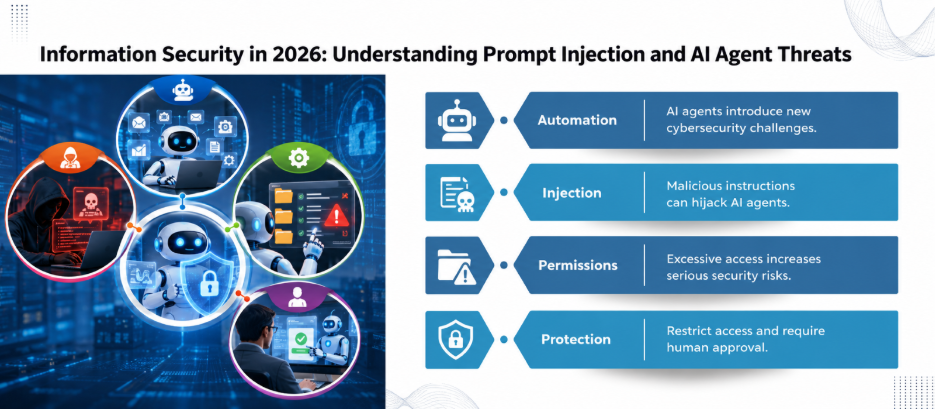
One of the most important risks is prompt injection. Attackers can hide malicious instructions in emails, documents, websites, or other content that an AI agent processes. The agent may interpret these instructions as relevant to its task and act on them.
Assume an AI assistant that summarises supplier emails and updates purchase records. A malicious email could contain instructions designed to make the agent reveal confidential information or modify a record without proper authorisation.
What businesses should do: Treat external content as untrusted, restrict the agent’s available actions, validate requests at the application level, and mandate human approval for sensitive operations. Prompt filtering alone is not a complete defence.
2. Excessive Permissions Can Turn Small Errors Into Major Incidents
AI agents often need access to business applications to complete their tasks. However, the problem starts when they receive more permissions than necessary.
Say you have an agent built to summarize financial reports. If it gets permission to modify accounting records or initiate payments, it could easily make a bad call. Those permissions could turn a simple mistake into a serious incident.
Here, the principle of least privilege is essential. Give each agent only the access it needs for a clearly defined task. Businesses should also use separate identities for agents, limit access to specific resources, rotate credentials where appropriate, and review permissions regularly.
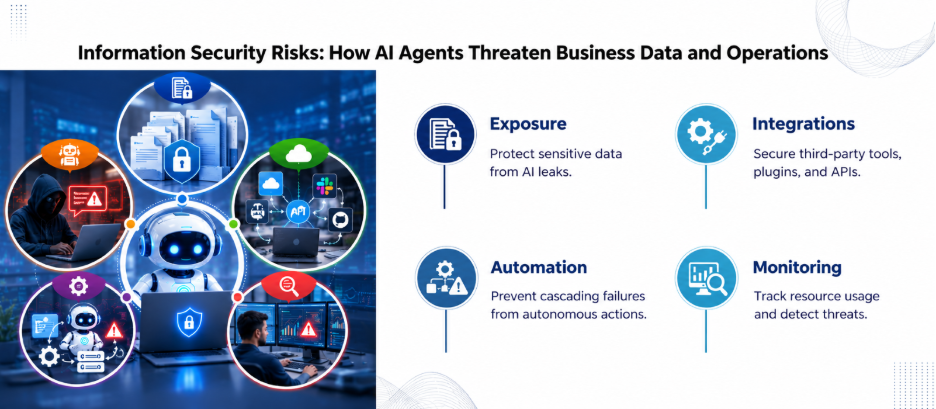
3. Sensitive Business Data Can Leak Through AI Workflows
Agents can retrieve information from several connected systems. This makes them useful for research and reporting, but it also creates additional paths through which confidential data might be exposed.
For example, a sales agent may access customer records, internal pricing documents, and email conversations. If its instructions, permissions, or output controls are poorly designed, it could disclose information to an unauthorised recipient.
Therefore, businesses should map the data each agent can access and classify it according to sensitivity. Personal information, financial records, intellectual property, and authentication credentials deserve particular protection.
Apply data minimisation, restrict external sharing, monitor data transfers, and review what gets stored in prompts, logs, and long-term agent memory. Avoid placing secrets directly into prompts or exposing confidential records to tools that don’t need them.
4. Connected Tools and Third-Party Integrations Expand the Attack Surface
An AI agent is only as secure as the systems and integrations it depends on. Plugins, APIs, external services, and agent communication protocols can introduce weaknesses if they are poorly configured or compromised.
A seemingly harmless integration might offer broader capabilities than the agent requires. Likewise, a compromised tool could also return misleading information or introduce malicious instructions into the workflow.
Therefore, before connecting a new tool, assess its source, permissions, authentication methods, data handling, and update process. Restrict network access where applicable, maintain an inventory of integrations, and remove unused connections.
This is where traditional security practices remain relevant. Strong endpoint protection, network controls, patch management, and secure configurations still matter when AI agents operate across business infrastructure.
5. Autonomous Actions Can Cause Cascading Failures
An agent may perform several actions in sequence. It might retrieve a document, interpret its contents, update a database, and notify another system. However, if the first step is compromised, later actions may amplify the damage. In multi-agent environments, the risk can spread further.
Businesses should therefore define clear boundaries for autonomous workflows. Set transaction limits, restrict which systems agents can modify, validate important changes independently, and mandate approval for high-impact actions, like transferring funds, changing access permissions, or deleting production data.
Maintain audit trails that record which agent acted, which tools it used, what data it accessed, and whether a person approved the action. These records can help security teams investigate incidents and identify where a workflow failed.
6. AI Agents Can Increase Infrastructure and Operational Risks
Not every AI-related security incident involves stolen data. Poorly controlled agents can also consume excessive computing resources, trigger repeated API calls, or make unwanted changes to infrastructure.
For example, an agent caught in a repetitive workflow could generate unexpected cloud or API costs. Similarly, an agent with access to deployment tools might introduce a faulty configuration that disrupts an important business service.
That’s why businesses should set execution limits, apply rate controls, monitor unusual resource consumption, and test failure scenarios before deploying agents in production.
Review the underlying IT environment as well. Nothing replaces secure configurations, reliable backups, access controls, and tested recovery procedures.
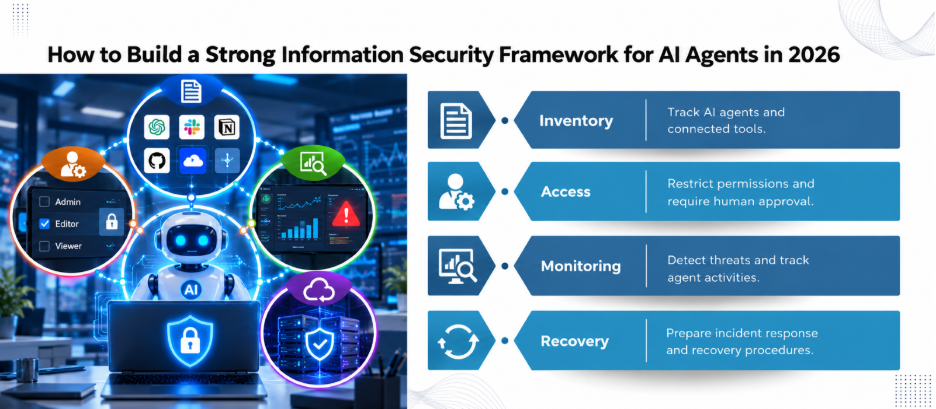
7. Build an Information Security Framework for AI Agents
- Maintain an AI inventory: Record each agent’s purpose, owner, connected tools, data access, and business impact.
- Classify actions by risk: Allow low-risk, reversible tasks to run with greater autonomy. However, apply stronger controls to financial, legal, administrative, and externally visible actions.
- Enforce independent authorisation: Check permissions in the systems an agent accesses rather than relying on the AI model.
- Test realistic attacks: Evaluate prompt injection, unauthorised data access, tool misuse, compromised integrations, and unexpected agent behaviour.
- Monitor continuously: Alert on unusual access patterns, repeated failures, unexpected data transfers, and attempts to exceed an agent’s defined scope.
- Prepare for recovery: Maintain a way to suspend an agent, revoke its credentials, reverse supported changes, and investigate its activity.
Final Thoughts
Agentic AI changes how organisations must approach information security. Software can now interpret instructions, access business systems, and take actions across connected workflows. Therefore, a single overly permissive agent may create risks that extend beyond the application in which it operates.
The practical response is to combine established security controls with agent-specific safeguards. Limit permissions, validate actions independently, protect sensitive data, and retain meaningful human oversight.
Building or scaling AI agents in your organisation? Talk to us about securing your environment.
FAQs
1. What is information security in the context of agentic AI?
It involves protecting business data, systems and processes when AI agents can access information and take actions autonomously.
2. What is the biggest security risk associated with agentic AI?
There is no single biggest risk for every organisation. Prompt injection, excessive permissions, data leakage, and unauthorised actions are important risks to assess.
3. How does prompt injection affect AI agents?
It can manipulate an agent through malicious instructions embedded in user inputs or external content, potentially causing unintended actions.
4. Can AI agents access confidential company data?
Yes, if their connected applications and permissions allow it. Access should be limited to the information required for each task.
5. How can businesses prevent AI agents from misusing permissions?
Use least-privilege access, separate agent identities, narrowly scoped tools, and independent authorisation checks.