Cybersecurity Compliance for SMBs: How Managed IT Services Keep You Audit-Ready
For a growing business, an audit isn’t just a quick check to see if you have a firewall or antivirus running. Auditors may want to know who can access sensitive information, how access is controlled, whether security incidents are logged, how vulnerabilities are addressed, whether backups are tested, and whether policies match what employees actually do.
This is where managed IT service providers become more than a technical support partner. When the relationship is structured correctly, they can help turn cybersecurity controls into repeatable operational processes.
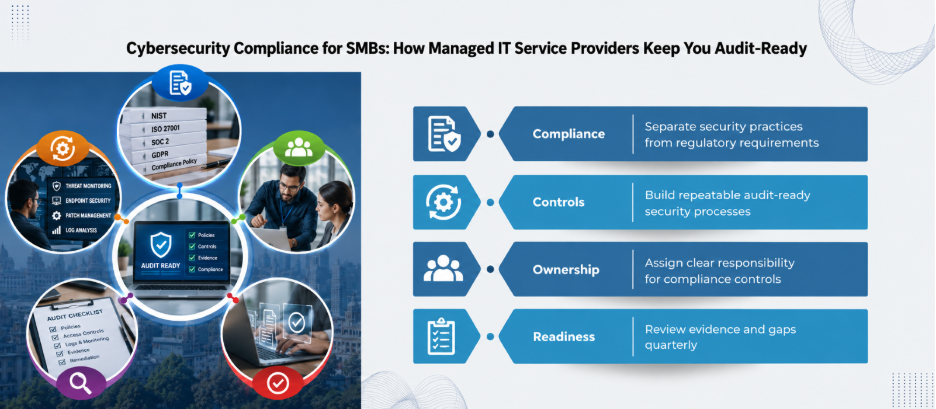
Compliance Is Not the Same as Cybersecurity
The first mistake SMBs make is treating compliance as a security checklist.
Security asks: How do we reduce the likelihood and impact of cyber incidents?
Compliance asks: What requirements apply to us, and can we demonstrate that we meet them?
Those questions overlap, but they are not identical.
For example, if you’re running a fintech startup or handling digital payments, you’re looking closely at RBI guidelines and PCI DSS standards for card security. For other businesses, contractual requirements or customer security questionnaires may drive the need for documented controls.
Therefore, buying security tools does not automatically make an organization compliant.
The Audit-Ready SMB Has a System of Evidence
An audit-ready business should be able to answer five basic questions:
- What systems and data do we have?
- Who can access them?
- What controls protect them?
- How do we know those controls are operating?
- Where is the evidence?
The real value of managed IT service providers comes from operationalizing these principles.
Instead of conducting a frantic security cleanup two weeks before an audit, an SMB can maintain a continuous cycle of asset management, patching, access reviews, monitoring, backup validation, incident handling, and documentation.
1. Start With an Asset and Data Inventory
You cannot protect what you do not know exists.
Your inventory should cover laptops, desktops, servers, network equipment, cloud applications, privileged accounts, business-critical applications, and major data repositories.
It should also identify where sensitive information resides and who has access to it.
This is especially important as businesses adopt SaaS platforms and hybrid work. Employees may create accounts outside the systems IT originally deployed. Therefore, a good managed service arrangement should maintain an accurate asset register and establish ownership for critical systems.
Our IT infrastructure guidance discusses how infrastructure management connects with security, scalability, and compliance.
2. Turn Access Control Into a Routine Process
An auditor may not be impressed by a written access-control policy if an employee who left six months ago still has an active account. Therefore, access management should become a recurring operational task.
At minimum, businesses should establish:
- Unique user accounts
- Role-based access where appropriate
- Multi-factor authentication for important systems
- Separate privileged accounts
- Timely removal of departing employees
- Periodic access reviews
- Documented approval for elevated privileges
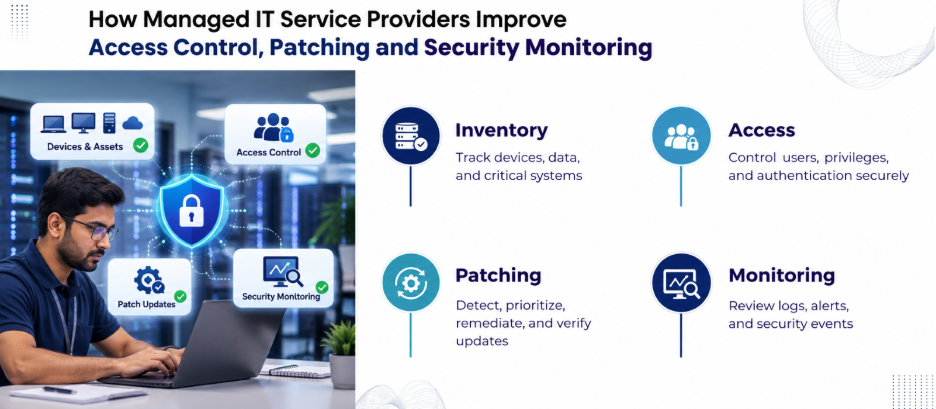
Managed IT service providers can automate or schedule many of these activities and retain records showing when accounts were created, changed, disabled, or reviewed.
3. Make Patch Management Auditable
“Everything is updated” is not an audit trail.
A stronger approach records which systems were assessed, which patches were applied, which devices failed to update, and how exceptions were handled.
Your team should be able to demonstrate:
Detection → prioritization → remediation → verification → exception management.
The same principle applies to operating systems, browsers, network appliances, endpoint security software, and business applications.
4. Treat Logs as Evidence, Not Just Technical Data
Logs become extremely valuable during an investigation or audit.
Depending on the environment and applicable requirements, useful records can include authentication events, administrator activity, endpoint alerts, firewall events, backup jobs, security incidents, and changes to critical systems.
But collecting logs is only half the job.
Someone needs to decide:
- What should be logged?
- How long should records be retained?
- Who can access them?
- What events require investigation?
- How are incidents documented?
For healthcare organizations and digital health platforms in India, compliance frameworks under the Ayushman Bharat Digital Mission (ABDM) and electronic health record standards require strict audit controls and logging for systems handling patient data.
5. Backups Need Proof, Not Promises
Backup status is another area where SMBs often confuse configuration with resilience.
A dashboard showing “backup successful” does not prove that the business can recover from ransomware, accidental deletion, hardware failure, or another disruptive event.
A mature process includes:
- Defined recovery objectives
- Multiple backup copies where appropriate
- Appropriate access restrictions
- Monitoring of backup jobs
- Periodic restoration tests
- Documented recovery procedures
- Records of test results and remediation
During an audit, restoration evidence can be far more useful than a screenshot of a backup product.
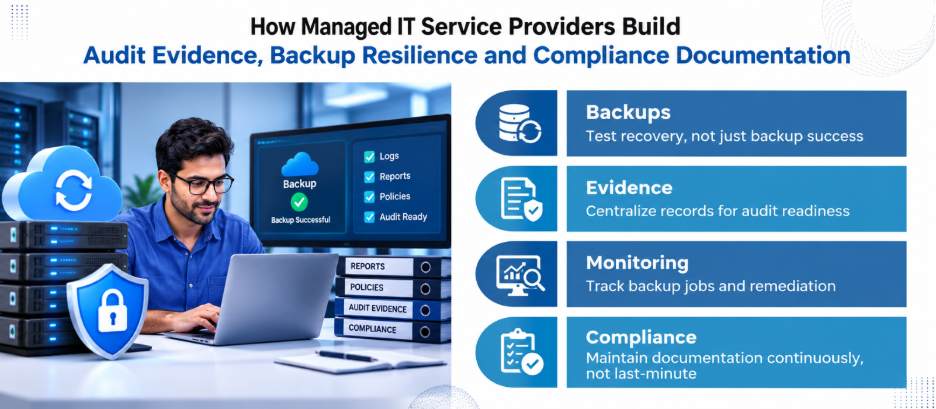
6. Build an Evidence Repository Before the Auditor Arrives
This may be the biggest practical advantage of working with managed IT service providers.
Instead of searching through email threads and spreadsheets, maintain a structured evidence repository containing items like:
- Asset inventories
- Access reviews
- Patch reports
- Vulnerability assessments
- Security incident records
- Backup and restoration reports
- Security-awareness training records
- Configuration standards
- Risk assessments
- Vendor records
- Policy acknowledgements
- Change-management records
The repository should also identify the date, owner, system, and purpose of each piece of evidence.
That makes audit preparation a maintenance activity rather than a fire drill.
7. Don’t Confuse an IT Provider With a Compliance Officer
This distinction is critical.
Managed IT service providers can implement and operate technical controls, maintain documentation, monitor systems, and provide evidence. However, they cannot automatically determine every legal or regulatory obligation that applies to your business.
A qualified compliance, legal, or security professional may be needed for regulatory interpretation.
8. Measure Readiness Before the Audit
Don’t wait for an auditor to discover the gaps.
Run a quarterly internal readiness review based on your risk profile.
Ask:
Control: What requirement are we addressing?
Owner: Who is responsible?
Evidence: What proves the control operates?
Frequency: How often is it performed?
Exception: What happens when it fails?
Remediation: Who fixes the problem, and by when?
This approach changes the conversation from “Are we compliant?” to “Can we demonstrate how our controls operate?”
That is a much more useful management question.
The Strategic Role of Managed IT Services
The best managed IT service providers do not simply close help-desk tickets. They create operational discipline around technology.
For an SMB, that can mean consistent patching instead of occasional updates, documented access reviews instead of informal permissions, tested backups instead of assumptions, and organized evidence instead of last-minute paperwork.
That mindset is important because audit readiness is not an event. It is the outcome of hundreds of small IT decisions being made consistently.
Final Takeaway
Cybersecurity compliance becomes considerably more manageable when SMBs stop treating it as an annual audit exercise. The goal is to build an IT environment where good security practices happen routinely, and your organization can demonstrate what it does, how it does it, and what happens when something goes wrong. That is what being genuinely audit-ready looks like.
Talk to us about a security and compliance assessment.
FAQs
1. What do managed IT service providers do for cybersecurity compliance?
They can operate and document technical controls like patch management, endpoint security, access management, monitoring, backups, and security reporting. Their exact responsibilities should be defined contractually.
2. Can an MSP make an SMB fully compliant?
No. Compliance depends on the regulations, contracts, standards, and risks applicable to the business. An IT provider can support the technical and operational controls, but organizational leadership remains responsible for its compliance obligations.
3. What evidence should an SMB maintain for an audit?
Common evidence includes asset inventories, access reviews, patch reports, vulnerability assessments, incident records, backup tests, security-training records, policies, risk assessments, and change records.
4. How often should access reviews be performed?
There is no universal frequency for every organization. The appropriate interval depends on the applicable requirement and risk profile. Many businesses establish periodic reviews and additional reviews following role changes or significant organizational changes.
5. Does having MFA automatically satisfy compliance requirements?
No. MFA is an important security control, but compliance requirements vary. An organization must evaluate MFA alongside access management, logging, policies, risk management, and other applicable controls.