How Cybersecurity Solutions Companies Are Protecting Businesses from Modern Threats
Cyber threats are becoming more sophisticated, frequent, and financially damaging for businesses of all sizes. From ransomware attacks and phishing campaigns to AI-powered cybercrime and supply chain breaches, organizations face constant pressure to protect sensitive data and maintain business continuity. This is where cybersecurity solutions companies play an important role.
Modern cybersecurity providers help businesses detect threats early, secure networks, monitor suspicious activity, recover from attacks, and reduce operational risk. Their services are especially valuable for small and medium-sized enterprises (SMEs), which often lack dedicated in-house security teams.
In recent years, ransomware attacks have surged globally, with threat actors increasingly targeting healthcare, manufacturing, technology firms, and SMEs. Multiple industry reports show a sharp rise in ransomware incidents and data extortion campaigns across industries.
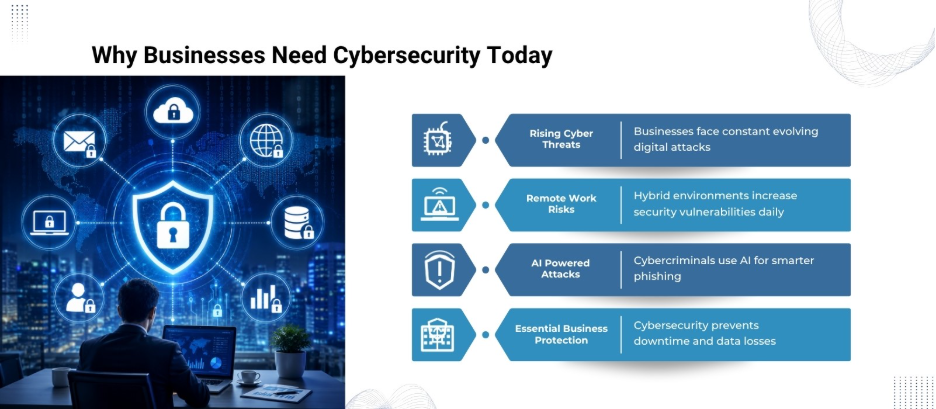
Why Businesses Need Cybersecurity More Than Ever
Cyberattacks are no longer limited to large enterprises. SMEs have become major targets because attackers often view them as easier to compromise. According to recent cybersecurity studies, more than half of SMEs experienced cyberattacks within a 12-month period.
Several factors are driving this rise in cyber threats:
- Increased remote and hybrid work
- Cloud adoption across industries
- Weak password and access practices
- AI-assisted phishing attacks
- Unpatched software vulnerabilities
- Third-party and supply chain risks
Cybercriminals are also shifting from simple encryption-based attacks to data theft and extortion strategies. This means businesses face reputational damage, legal complications, operational downtime, and financial losses even if they recover their systems from backups.
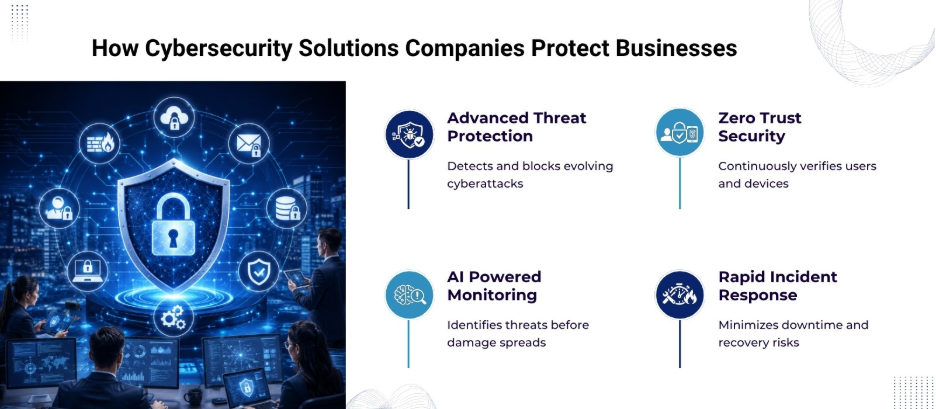
What Do Cybersecurity Solutions Companies Do?
Fortinet and many other cybersecurity providers deliver technologies and managed services that help organizations strengthen their digital defenses.
Their services typically include:
| Cybersecurity Service | Purpose |
| Endpoint Protection | Protects laptops, servers, and mobile devices from malware |
| Managed Detection and Response (MDR) | Monitors networks 24/7 for suspicious activity |
| Cloud Security | Secures cloud applications and infrastructure |
| Identity and Access Management (IAM) | Controls user access and authentication |
| Zero Trust Security | Verifies every user and device continuously |
| Threat Intelligence | Identifies emerging cyber risks before attacks occur |
| Security Awareness Training | Educates employees about phishing and cyber hygiene |
| Incident Response | Helps organizations contain and recover from attacks |
| Backup and Disaster Recovery | Reduces downtime after ransomware incidents |
Many cybersecurity solutions companies now combine artificial intelligence, automation, and behavioral analytics to detect threats faster and reduce response time.
The Growing Threat of Ransomware
Ransomware remains one of the most dangerous cybersecurity threats facing businesses today. Attackers encrypt files or steal sensitive data and demand payment to restore access or prevent public exposure. Cybersecurity solutions companies combat ransomware using multiple defensive layers, including:
1. Endpoint Detection and Response (EDR)
EDR systems monitor devices continuously to identify unusual behavior such as mass file encryption, unauthorized access attempts, or suspicious software execution.
2. Advanced Email Security
Phishing emails remain a leading attack vector. Therefore, security providers deploy AI-powered email filtering systems to block impersonation attempts, malicious links, and malware attachments.
3. Threat Intelligence Monitoring
Threat intelligence platforms track ransomware groups, dark web activity, and emerging vulnerabilities to help businesses respond proactively.
4. Secure Backups
Modern cybersecurity strategies focus heavily on backup isolation and disaster recovery. Immutable backups help businesses recover without paying ransom demands.
5. Employee Awareness Training
Human error continues to contribute to successful cyberattacks. As a result, cybersecurity providers offer simulated phishing exercises and awareness programs to reduce employee-related risks.
How Zero Trust Security Is Changing Cyber Defense
One of the most important cybersecurity trends today is the adoption of Zero Trust Security.
Traditional security models assumed that users and devices inside a company network could be trusted. Zero Trust eliminates that assumption. Instead, every access request must be continuously verified regardless of where the user is located.
The core principle of Zero Trust is:
Never trust, always verify.
Academic research and industry reports highlight that Zero Trust frameworks reduce risks associated with insider threats, remote work, credential theft, and lateral movement within networks.
| Zero Trust Component | Function |
| Multi-Factor Authentication (MFA) | Adds extra identity verification |
| Least Privilege Access | Limits user permissions |
| Continuous Monitoring | Tracks behavior in real time |
| Device Verification | Confirms device security status |
| Micro-Segmentation | Restricts network movement |
| Identity-Based Access Control | Verifies users before granting access |
Cybersecurity solutions companies are rapidly integrating Zero Trust principles into cloud platforms, remote work systems, and enterprise applications.
Why SMEs Need Cybersecurity Solutions Companies
Many SMEs mistakenly believe cybercriminals only target large corporations. In reality, smaller businesses often face higher risk because they may lack:
- Dedicated IT security staff
- Advanced monitoring tools
- Regular vulnerability assessments
- Security awareness training
- Incident response plans
For SMEs, even a single ransomware incident can disrupt operations for days or weeks. Financial losses may include:
- Recovery costs
- Lost productivity
- Regulatory penalties
- Reputation damage
- Customer trust issues
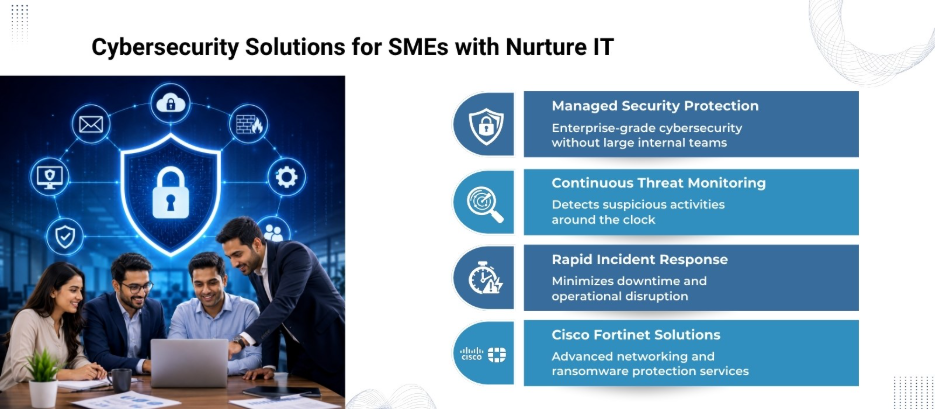
Managed cybersecurity services provide SMEs with enterprise-level protection without requiring large internal teams.
Benefits for SMEs
Cost-Effective Protection
Outsourcing cybersecurity services is often more affordable than building a full in-house security department.
24/7 Threat Monitoring
Managed security providers monitor systems continuously and respond to suspicious activity quickly.
Faster Incident Response
Cybersecurity companies help businesses isolate threats, restore systems, and minimize operational disruption.
Compliance Support
Security providers assist businesses with compliance frameworks like the DPDP Act 2023 and industry-specific regulations.
Reduced Downtime
Strong backup strategies and proactive monitoring help businesses recover faster after attacks.
AI Is Transforming Cybersecurity
Artificial intelligence is changing both cyberattacks and cyber defense.
Threat actors now use AI to automate phishing campaigns, create convincing fake communications, and identify system vulnerabilities more efficiently. At the same time, cybersecurity solutions companies are using AI-driven technologies to strengthen detection and response capabilities.
AI-powered cybersecurity tools can:
- Detect unusual behavior patterns
- Analyze massive volumes of network data
- Identify zero-day threats
- Automate incident response
- Predict emerging attack trends
Machine learning models also improve ransomware detection by identifying malicious behavior before encryption spreads across networks.
Essential Cybersecurity Best Practices for Businesses
Even with strong cybersecurity partners, organizations should follow security best practices internally.
Use Multi-Factor Authentication
MFA significantly reduces risks associated with stolen passwords.
Keep Software Updated
Many attacks exploit outdated software vulnerabilities.
Train Employees Regularly
Security awareness training helps employees recognize phishing and social engineering attacks.
Back Up Critical Data
Businesses should maintain secure, isolated, and regularly tested backups.
Adopt Zero Trust Policies
Continuous verification reduces the risk of unauthorized access.
Conduct Security Audits
Regular vulnerability assessments help identify weaknesses before attackers do.
Strengthen Your Business Security with Nurture IT in Indiranagar
Nurture IT, one of the best cybersecurity solutions companies in Bangalore, helps businesses strengthen their cybersecurity posture with advanced networking, cloud, and managed IT solutions tailored for modern enterprises.
As official dealers of Cisco and Fortinet, Nurture IT provides enterprise-grade cybersecurity and networking technologies trusted worldwide. Cisco solutions include secure networking, managed detection and response (MDR), endpoint security, network infrastructure, security operations, and cloud-based protection services. Fortinet offers next-generation firewalls, Secure SD-WAN, Zero Trust Network Access (ZTNA), SASE, SIEM, XDR, endpoint security, cloud security, and AI-driven threat intelligence solutions.
From securing hybrid work environments to strengthening ransomware protection and network visibility, Nurture IT helps SMEs and enterprises build resilient, high-performance, and security-focused IT ecosystems.
Final Thoughts
Cyber threats are becoming more complex, persistent, and financially damaging. Ransomware groups, AI-assisted attacks, phishing campaigns, and supply chain breaches now affect businesses across every industry.
Therefore, investing in cybersecurity is no longer optional. Strong cybersecurity strategies help businesses reduce downtime, protect sensitive data, maintain customer trust, and respond effectively to modern cyber threats.
Whether you are an SME or a growing enterprise, Nurture IT delivers reliable cybersecurity and IT solutions that support long-term digital resilience.
FAQs
1. What is Zero Trust security?
Zero Trust security is a cybersecurity framework based on the principle of “never trust, always verify.” It requires continuous authentication and authorization for every user, device, and application attempting to access company resources.
2. Why do SMEs need cybersecurity solutions?
SMEs are common targets for cyberattacks because many lack dedicated security teams and advanced protection systems. Cybersecurity solutions help SMEs reduce downtime, secure sensitive data, and improve threat detection.
3. How do cybersecurity solutions companies help prevent ransomware?
Cybersecurity providers use endpoint protection, AI-driven monitoring, email security, secure backups, employee training, and threat intelligence systems to detect and stop ransomware attacks before they spread.
4. What services do cybersecurity solutions companies offer?
Common services include managed detection and response (MDR), cloud security, endpoint security, firewall management, security audits, identity and access management, backup solutions, and incident response support.
5. How does AI improve cybersecurity?
AI improves cybersecurity by analyzing large amounts of data, identifying suspicious behavior, detecting threats faster, automating responses, and helping security teams respond to attacks more efficiently.