AIOps and IT Infra Services: How AI Is Changing Infrastructure Management in 2026
A server slows down during peak business hours, and employees lose access to shared files or network latency disrupts video meetings. Traditionally, IT teams would investigate alerts, check logs, and troubleshoot each issue manually. By the time they identify the cause, productivity may already take a hit.
In 2026, Artificial Intelligence for IT Operations (AIOps) is changing this approach. By analysing operational data, identifying unusual patterns, and supporting automated responses, AI helps IT teams detect problems earlier and manage increasingly complex environments.
For businesses investing in IT infra services, the opportunity goes beyond faster troubleshooting. AIOps can improve visibility, reduce repetitive work, and help infrastructure teams make better decisions about performance, security, and costs.
What Is AIOps in Infrastructure Management?
AIOps refers to using artificial intelligence, machine learning, analytics, and automation to improve IT operations. These systems analyse data from sources like system logs, performance metrics, network events, and application traces to identify patterns that traditional monitoring tools may miss.
For example, a conventional monitoring tool might alert an administrator when server CPU usage exceeds a threshold. But an AIOps platform can correlate that spike with memory consumption, application latency, recent configuration changes, and similar historical incidents to suggest a likely cause.
Some platforms can also trigger predefined remediation workflows. However, their effectiveness depends on data quality, integration, and the safeguards governing automated actions.
AIOps does not replace infrastructure engineers. It helps them spend less time sorting through alerts and more time addressing complex issues.
How AI Is Changing IT Infra Services in 2026?
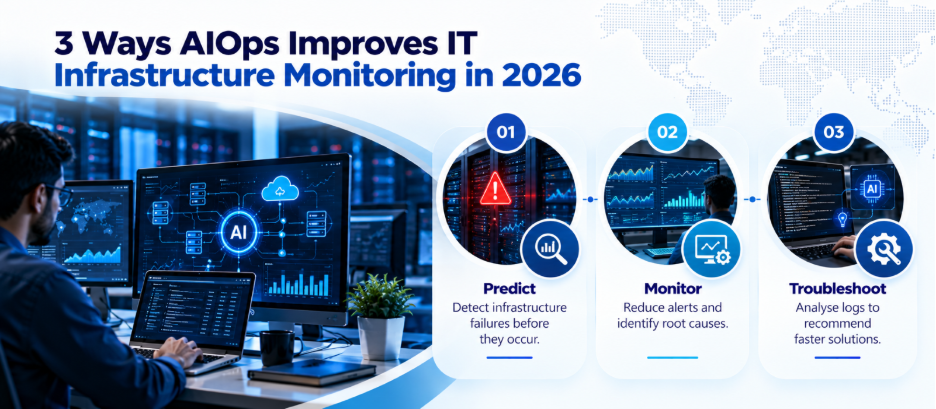
1. Predictive Maintenance Instead of Reactive Repairs
Traditional infrastructure management often responds to failures after performance deteriorates or a component stops working. However, AI-based analytics can identify warning signs earlier.
For example, a system might detect recurring storage latency, unusual memory consumption, or a pattern of network errors. These signals can prompt an investigation before users experience a major disruption.
However, predictions are not guarantees. IT teams should validate alerts against actual system conditions and track how often predictions prove useful.
2. Smarter Monitoring and Fewer Alert Overloads
Large IT environments generate thousands of events across endpoints, servers, networks, cloud platforms, and applications. Many alerts are related to the same underlying problem.
AIOps tools can correlate related events and group them into a single incident. Instead of receiving separate notifications for an overloaded server, slow application response, and failed requests, an engineer may see a connected view of the issue.
This is particularly useful for businesses using multiple infrastructure platforms.
For organisations reviewing their IT helpdesk and infrastructure maintenance requirements, combining intelligent monitoring with a clear ticket-management process can help teams prioritise incidents and track resolutions more effectively.
3. Automated Troubleshooting and Incident Resolution
AI can support troubleshooting by analysing logs, comparing current behaviour with historical incidents, and recommending likely fixes.
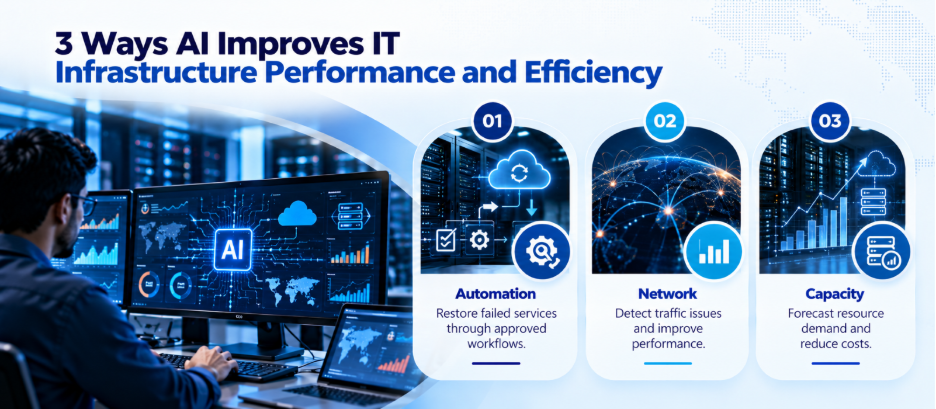
Depending on the platform and configured permissions, automation can restart a failed service, scale an application, or execute an approved recovery procedure.
Consider a business application that becomes unresponsive because a service has stopped. An automated workflow could detect the failure, restart the service, verify its health, and notify the support team.
4. Better Network Performance and Visibility
Network issues can originate from overloaded links, faulty equipment, wireless interference, misconfigurations, or external connectivity problems. Identifying the source becomes harder when a business operates across several offices or supports remote employees.
AI-assisted network analytics can identify traffic anomalies, highlight recurring congestion, and help administrators investigate performance changes.
However, these capabilities complement, rather than replace, fundamental network planning. Therefore, correct switch configurations, suitable routers, reliable connectivity, and appropriate security controls remain important.
5. Smarter Capacity Planning and Cost Management
Overprovisioning infrastructure increases costs, while insufficient capacity can affect application performance. On that note, AI-assisted analytics can help teams understand utilisation patterns and forecast future resource requirements.
For example, a company might discover that its virtual machines consistently use less CPU capacity overnight but experience predictable demand spikes during business hours. This information can support more informed scaling decisions.
Cloud environments may also benefit from recommendations about idle resources, storage consumption, and workload placement.
What Should Businesses Consider Before Adopting AIOps?
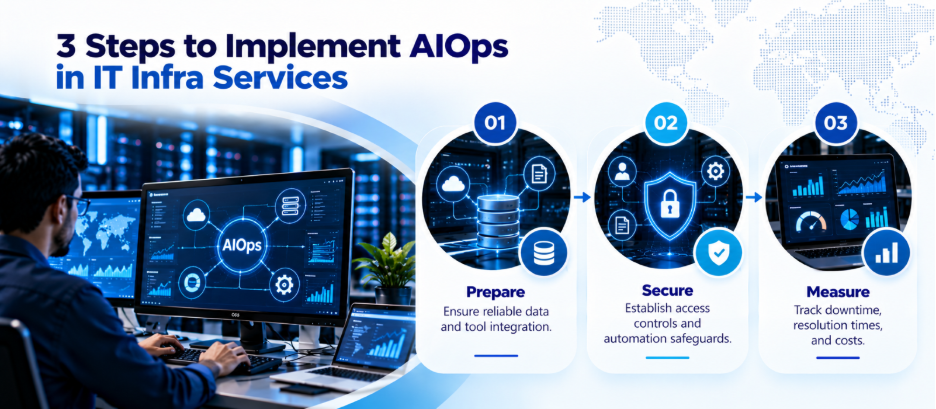
Successful adoption requires more than purchasing an AI tool. Businesses should address several practical considerations before introducing automated infrastructure management.
- Data quality: Inconsistent timestamps, incomplete logs, and missing telemetry can produce misleading results.
- Tool integration: Monitoring, ticketing, endpoint management, and network tools should share relevant operational information.
- Security and access: AI systems and automation workflows need restricted permissions, audit trails, and appropriate access controls.
- Human oversight: High-impact changes should have approval requirements, rollback plans, and clear ownership.
- Measurable outcomes: Track incident frequency, mean time to resolution (MTTR), false-positive rates, downtime, and infrastructure spending.
Start with one recurring problem, establish a baseline, test the proposed solution, and compare results before expanding the deployment.
The Role of IT Infra Services Providers in the AIOps Era
AI tools work best when they operate within a well-managed infrastructure environment. Therefore, businesses still need professionals to configure systems, maintain hardware, manage networks, apply security updates, and respond when automated processes cannot resolve an issue.
This is especially relevant for startups and small or medium-sized businesses that may not have a large internal IT team. A service provider can help assess existing infrastructure, identify recurring operational problems, standardise configurations, and establish maintenance processes. These foundations can make future AI adoption more practical.
For example, our Annual Maintenance Contract services cover areas like troubleshooting, system updates, software maintenance, and hardware repairs. Such structured support can complement AI-enabled monitoring, although the published service description does not establish that AIOps itself is included.
Businesses should clarify which monitoring, automation, and AI capabilities a provider actually offers before choosing a service package.
What Does the Future Hold for AIOps?
In 2026, infrastructure operations are moving towards greater integration between observability, automation, and AI-assisted decision-making. Some platforms are also introducing AI agents that can investigate operational problems and recommend or execute actions within defined boundaries.
Organisations that build these foundations can adopt advanced capabilities gradually, based on measurable business needs rather than technology hype.
Contact us to explore the right IT support for your organisation and build a stronger foundation for AI-ready infrastructure.
FAQs
1. What is AIOps in IT infrastructure management?
AIOps uses AI, machine learning, and analytics to help monitor IT systems, detect anomalies, correlate alerts, investigate incidents, and support operational automation.
2. How does AIOps improve IT operations?
It can reduce alert noise, speed up troubleshooting, identify unusual system behaviour, and automate selected routine responses. Results depend on implementation quality and the operational environment.
3. Is AIOps suitable for small businesses?
Yes. Small businesses can start with targeted applications, such as alert correlation or automated responses to recurring problems, provided the costs and technical requirements fit their needs.
4. Does AIOps replace IT administrators?
No. It supports administrators by handling selected analytical and repetitive tasks. People remain responsible for oversight, complex troubleshooting, security decisions, and business-critical changes.
5. Can AIOps prevent downtime?
It can help identify warning signs and support faster remediation, potentially reducing downtime. It cannot predict or prevent every failure.