How AI Is Changing IT Outsourcing Services in India in 2026
Artificial intelligence is changing what businesses expect from their IT partners. Tasks that once required hours of manual work, like reviewing system logs, categorising support tickets, and writing routine code, can now be partially automated. However, adopting AI is not simply about adding a chatbot to an existing workflow.
For businesses evaluating IT outsourcing services in India, the bigger question is how technology partners can use AI to improve reliability, security, productivity, and operational costs.
India’s technology services industry is responding to this shift. A February 2026 NITI Aayog roadmap points out that industries are prioritising AI, automation, digital tools, and outcome-focused services. Therefore, the sweet spot is pairing AI with actual human expertise and responsibility.
1. IT Support Is Moving from Reactive to Predictive
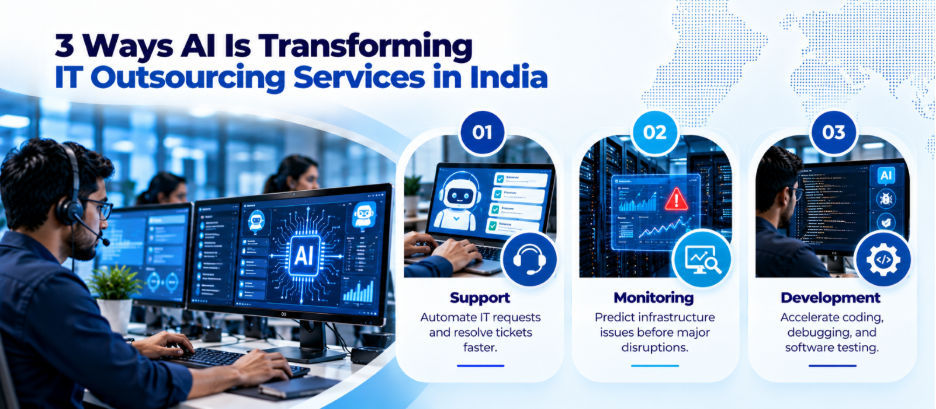
Traditional IT support often begins after something goes wrong. An employee reports a slow laptop, a server becomes unavailable, or a network connection fails. The support team then investigates and resolves the issue.
AI-assisted monitoring can help identify warning signs earlier. Depending on the tools and data available, systems can analyse device performance, recurring incidents, storage utilisation, and network activity to flag potential problems.
For example, repeated laptop crashes across a department may indicate a software compatibility issue rather than several unrelated incidents. Identifying that pattern can help the IT team investigate the underlying cause.
For companies using IT outsourcing services in India, this can mean fewer avoidable disruptions and better visibility into recurring problems.
Ask potential providers whether they offer proactive monitoring, scheduled maintenance, root-cause analysis, and incident reports. AI is useful only when insights lead to timely action.
2. AI Is Changing IT Helpdesk Operations
AI assistants can help employees resolve common IT issues without waiting for a technician. They can guide users through password-reset procedures, software troubleshooting, basic connectivity checks, and standard support requests.
AI can also classify incoming tickets, summarise conversations, suggest solutions from internal knowledge bases, and route complex issues to the right support team.
However, automation has limits. A failed hardware component, a suspected security breach, or an issue involving privileged access may require direct human intervention.
Therefore, businesses should evaluate IT support providers based on how effectively they combine automated assistance with human escalation. Our IT maintenance and support services are a good starting point to understand structured ticket handling, remote troubleshooting, and ongoing infrastructure maintenance.
3. Software Development and Testing Are Becoming More Efficient
Generative AI tools can assist developers with code suggestions, documentation, test generation, and debugging. They can also help teams understand unfamiliar codebases and identify areas that need further review.
These capabilities can shorten parts of the development process, but they do not eliminate the need for skilled engineers. AI-generated code may contain errors, security weaknesses, outdated approaches, or incorrect assumptions about business requirements.
That’s why a practical outsourcing partner should combine AI-assisted development with code reviews, automated testing, security checks, and human approval.
For businesses, the key metric is not how much code AI produces. It is whether the final software is reliable, maintainable, secure, and delivered within agreed timelines.
4. Predictive Maintenance Is Improving IT Infrastructure Management
IT infrastructure includes laptops, desktops, servers, networks, and other equipment. However, managing these assets across multiple offices can become complicated as a company grows.
AI-assisted analytics can help identify recurring hardware failures, unusual performance patterns, and equipment that may require attention. When integrated with monitoring systems, these insights can support more informed maintenance decisions.
For instance, if a group of devices keeps overheating or have storage problems, the IT team can investigate before the issue affects more employees.
This approach works best when you keep track of your assets, stay on top of maintenance schedules, and ensure everyone knows who is fixing what when alerts pop up.
Businesses can also review our networking solutions to understand the infrastructure components that support reliable connectivity and business operations.
5. Cybersecurity Is Becoming More Intelligence-Driven
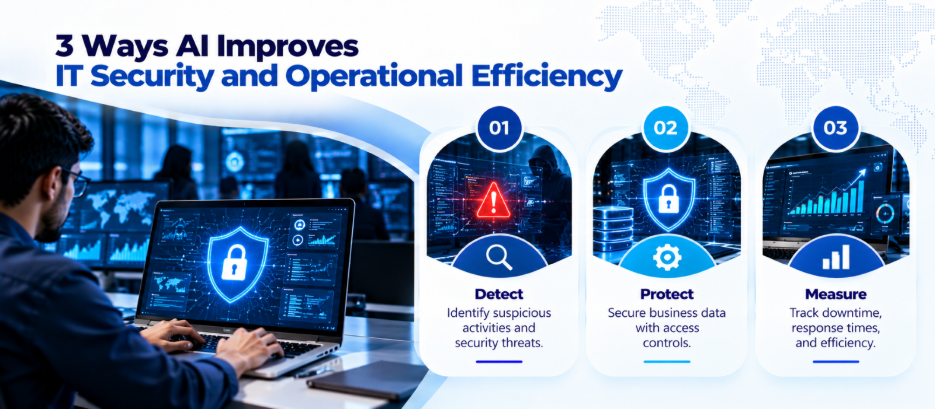
AI has applications on both sides of cybersecurity. Security teams can use it to analyse large volumes of activity, identify unusual login patterns, prioritise alerts, and investigate potential threats. Attackers can also use AI to produce convincing phishing messages, automate reconnaissance, and adapt their techniques.
That’s why it creates a need for stronger security processes.
Businesses should assess whether their IT partner supports multi-factor authentication, access controls, endpoint protection, secure backups, incident response, and regular security reviews.
However, AI-generated alerts also require careful handling. False positives can overwhelm support teams, while missed threats can create serious risks.
6. Outsourcing Contracts Are Shifting Towards Measurable Outcomes
AI can automate parts of routine IT work. As a result, businesses may question traditional pricing models based primarily on staff hours or ticket volumes.
That’s why companies are moving to agreements tied directly to real-world outcomes, productivity gains, reliability, and hard metrics. This does not mean every outsourcing contract has changed, but clients increasingly have reason to examine what they are actually paying for.
Therefore, when evaluating IT outsourcing services in India, businesses should agree on measurable service-level indicators, like:
- Average incident resolution time
- System availability and downtime
- First-contact resolution rate
- Recurring incident frequency
- Security incident response procedures
- Cost per supported employee or device
These metrics help distinguish genuine operational improvements from claims based on AI adoption alone.
7. Data Privacy and Governance Matter More Than Ever
AI tools may process sensitive business information, including employee records, customer details, source code, and internal documents. Sending this information to an unapproved AI service can create confidentiality, contractual, or regulatory risks.
Before deploying AI, businesses should establish which tools employees may use, what data can be entered, who can access outputs, and how information is retained.
Providers should also explain how they handle data access, encryption, audit logs, model-provider terms, and incident reporting. Where relevant, organisations must assess applicable privacy and sector-specific requirements.
A practical starting point is to classify data into public, internal, confidential, and restricted categories. Then define which AI applications are permitted to process each category.
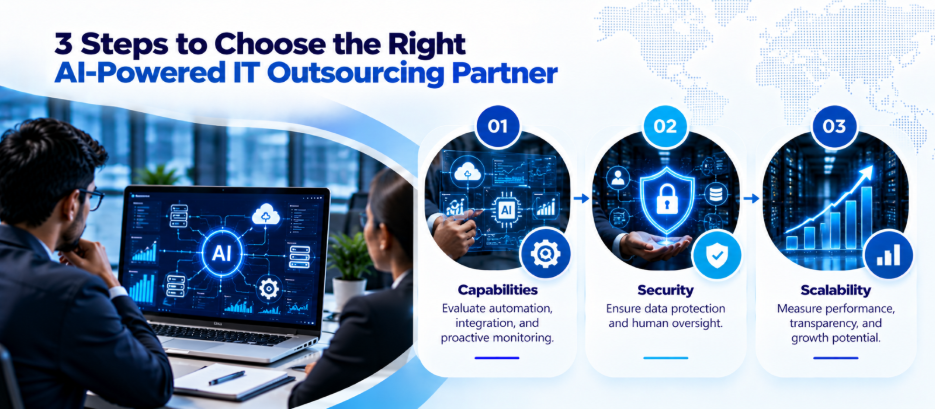
8. What Should Businesses Look for in an AI-Ready IT Partner?
Not every company needs a sophisticated AI platform immediately. Many businesses will gain more value by improving their existing IT processes before introducing advanced automation.
Therefore, use this checklist when evaluating providers:
- Clear use cases: Can the provider identify specific problems AI will solve?
- Human oversight: Do qualified professionals review complex incidents?
- Security controls: Do your documented data protection policies cover AI tools?
- Integration capability: Can the solution work with existing systems and workflows?
- Transparent reporting: Can the provider demonstrate measurable improvements?
- Scalable support: Can services adapt as the company grows?
For smaller businesses, a phased approach is often more practical than a large AI transformation project. Start with one recurring problem, measure the results, and expand only when the benefits justify the investment.
Final Thoughts
AI is reshaping IT outsourcing through faster support, improved monitoring, assisted software development, and more data-driven security. Yet the technology alone does not deliver reliable IT operations. Therefore, strong processes, secure infrastructure, experienced professionals, and measurable accountability remain important.
Looking for help with your tech setup, networking, or security? Get in touch with us!
FAQs
1. How is AI changing IT outsourcing services in India in 2026?
AI makes handling basic support tasks, supervising system performance, writing code, and tracking down security threats easier. However, the results depend on implementation quality and human oversight.
2. Can AI replace outsourced IT support teams?
No. AI can handle certain repetitive tasks, but complex troubleshooting, hardware repairs, security incidents, and business-critical decisions still require human expertise.
3. How does AI reduce IT operational costs?
AI reduces manual effort, helps identify recurring problems, and shortens some troubleshooting tasks. However, actual savings depend on implementation costs, service quality, and how much work you can automate.
4. Is AI useful for small and medium-sized businesses?
Yes. Smaller businesses can benefit from AI-assisted helpdesks, monitoring, and workflow automation without necessarily building their own AI systems.
5. Can AI improve cybersecurity for outsourced IT operations?
AI can help detect unusual activity and prioritise security alerts. It cannot eliminate cyber risks and should operate alongside access controls, endpoint protection, backups, and incident response procedures.